

Chris Greaves
Ship name / Flight number: TSS Fairstar
Arrival Date: 21/06/1966
b. 1948
I was born in my grandmother’s house in Shirley, a small town in the Metropolitan Borough of Solihull, England, on 7 August 1948. I have a younger brother, Terry. My dad worked in the Rover Car Factory and then for himself laying timber floors. My mum was at home and when we went to school, she got a part-time job managing a school canteen. I grew up on a council estate that was built around a park.
The park had enough room for us to play football (soccer) in the winter and cricket in the summer. This was how I spent my weekends. There wasn’t an organised competition, we’d just turn up and play. I was very tall for my age and was usually picked to be a goalkeeper.
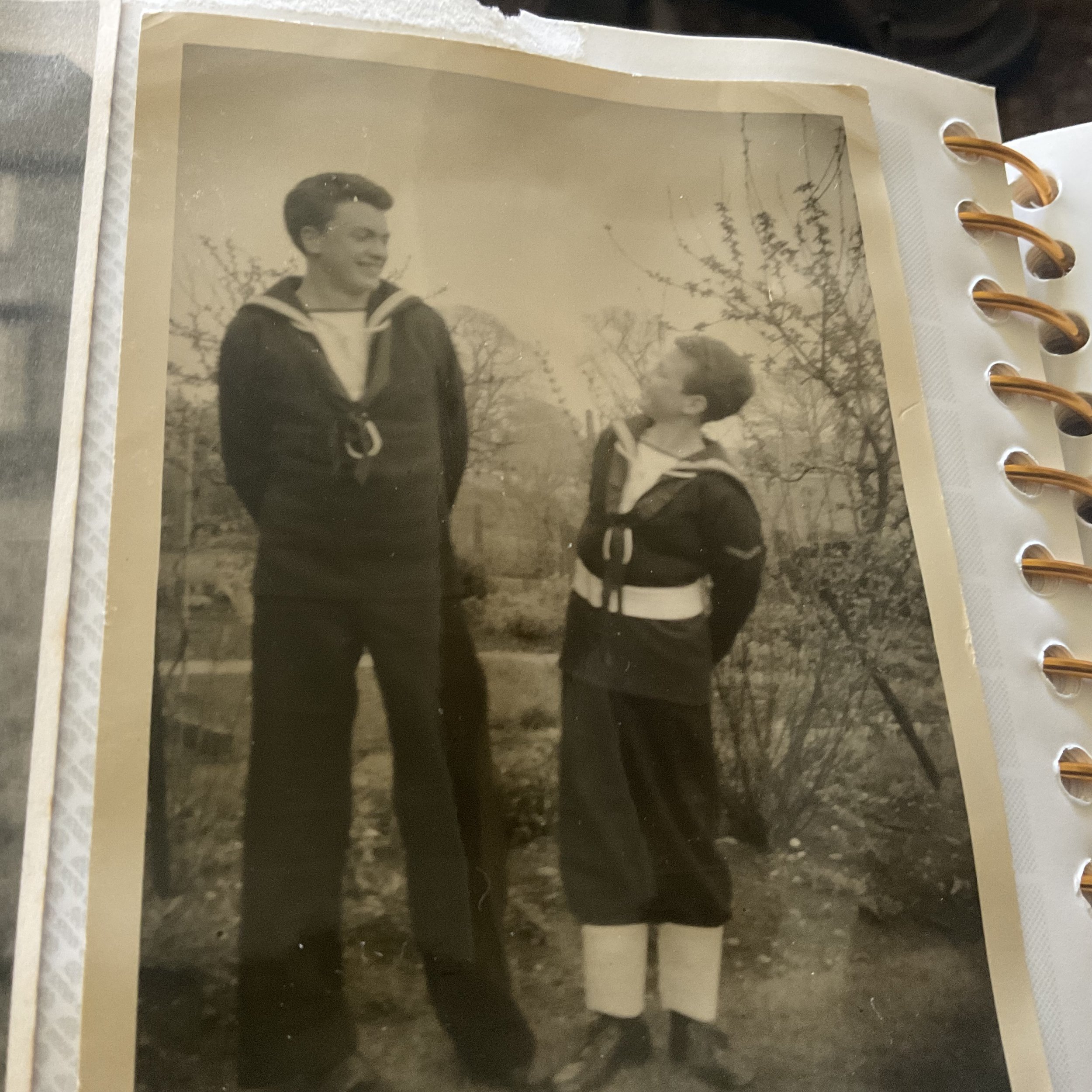
Chris (left) and his mate Gordon at the navy cadets in 1965.
We were known as “housos” because we lived on a housing estate. When my parents bought a house in Olton on the other side of Solihull in 1964, we thought we were rich, because they owned a home.
Terry and I went to school in Lodeheath. I was good at sport but that was about it. I sat for the intermediate high school certificate and the sports master, Mr Popplestone, made sure I passed because he wanted me to stay at school so I could keep playing on the rugby union team. I was the second biggest kid in the school and a good full forward. However, I decided to leave school anyway and worked for my father’s flooring business. In 1965 and 1966, I also worked part time as a lifeguard at the Solihull lido and indoor swimming complex.
My dad had family members who had moved to Australia and he always wanted to immigrate but my mother didn’t want to. On Friday nights we’d go to my grandmother’s house to play cards and sometimes go across the street to Aunt Florrie’s place to watch home movies sent on 8mm film by her relatives in Australia. I liked the look of the place and decided that I’d like to experience living there.
My father took me to Australia House in Birmingham for an interview with the BBM. They said because I was only 15 years old, I would have to work for two years on a farm, but if I waited until I was 17 years old, I’d have a wider range of work options, including in the city. I was enjoying working for my father at the time, and decided that I didn’t want to work on a farm, so I waited until I was 17 years old. On reflection, I wish I’d migrated when I was 15 years old to experience living and working on an Aussie farm.
I seriously considered joining the British navy but withdrew my application and re-applied to the BBM when I was 17 years old. I was accepted and offered a ticket for an airplane or an ocean liner. I decided to sail and caught the train from Birmingham to Southampton on my own. I met 19 other ‘Little Brothers’ on the dock at Southampton and we boarded the TSS Fairstar, ‘the fun ship’ of the Sitmar Line, in 1966.
I sailed into Sydney Harbour on 21 June 1966. My two uncles who lived in Australia came to greet me. I took a bus to Burwood with the other Little Brothers and stayed at the hostel for a week or so.
On our first day in Sydney, we all went to Bondi Beach for a swim! I still chuckle at the thought of all these white-skinned Pommies on the beach in winter.
The BBM helped me to get a job by giving me the names of three companies I could contact. Given my experience laying timber floors, I knocked on the door of a timber company called Thatcher and Oberg in Kingsford. When the manager, Ted Cross, saw how big I was, he assumed I was over 21 years of age and would need to be paid an adult wage, so he told me that there were no jobs available. As I was leaving, he asked how old I was and when I told him I was 17, he said: “you’ve got the job”. I was only earning $30/week but it was enough to live on.
I found a place to rent with a little old lady called Mrs Cooke who ran a boarding house on Eastern Avenue in Kingsford. I lived there with three other ‘Little Brothers’ for 12 months. Mrs Cook provided all our meals and I could easily catch the bus to work. On the weekends I went to the beach or did ten-pin bowling.
I wrote letters to mum and dad telling them how good Sydney was and convinced them to immigrate. My parents and Terry came out in 1967 as ‘Ten Pound Poms’.
When my parents arrived, I went to live with them in Coogee. It was lovely but a bit expensive (even in 1967!) so we moved to a unit in Wiley Park, near Bankstown. We lived there for about 12 months until they bought a house at Padstow Heights.
I didn’t continue playing rugby union in Australia, but I went back to football (soccer). My uncle got me a trial with Hakoah, a Jewish team based at Bondi which is now known as Sydney FC. I played in their reserves for 12 months but it was hard to get to know my teammates. When I moved to Padstow Heights with my family, I joined a Bankstown team. I played until I was 24 years old and started to get pain in my back, which ended my sporting career. If I’d stuck it out, I might have been a good player.
My dad and I started our own business called Greaves Floor Sanding. We sometimes worked as sub-contractors for George Hudson Parquetry (based in Glebe). It was going well until I injured my back with all the bending and lifting.
I was also going ten-pin bowling with my brother, which may not have been good for my back. But on the plus side, it’s how I met my wife – we were both in the same ten-pin bowling league at Hurstville. We both had boyfriends and girlfriends when we met in 1970, but when I heard that Rhonda was single, I rang her up and asked her out. She said no at first, but when I invited her to see the fireworks over Sydney Harbour, for the bicentenary of Captain Cooks’ mapping of the east coast of Australia, from a top floor in the Australia Square office block, she said yes! I had Terry to thank for the tickets, because he worked for Crysler who had their offices in Australia Square.
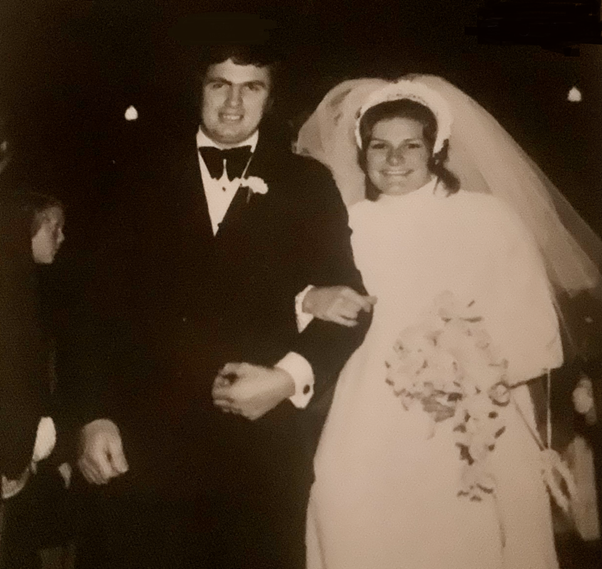
Chris and Rhonda’s wedding in Sydney, 1972.
Rhonda, whose maiden name of ‘Gread’ is uncannily similar to ‘Greaves’, and I were married in September 1972 in an Anglican Church across the road from the Hurstville bowling alley where we met. My grandparents travelled to Sydney for our wedding. Fifty-six years and three children later, we’re still married.
In 1972, Dad and I were getting lots of work through George Hudson but in 1974, the economy collapsed. No one could afford to buy kit homes or have their floors sanded. I had no work and a growing family – our first child, Jacqueline, was born in 1974. We also had a mortgage, having bought a house at Milperra, near Bankstown, in 1972.
Luckily, I scored a job with Cobbitty Farm Bakery delivering bread to corner stores and supermarkets. I worked for them for 12 months and was promoted to the role of supervisor of deliveries.
In 1975 the economy picked up and George Hudson Parquetry offered me a job as a Mr Fix-it. I worked for them for the next eight years and worked my way up to the role of Installation Manager. Rhonda and I had two more children during this time: Trevor was born in 1977 and Gavin in 1981. Unfortunately, my job took me away from home for up to six weeks at a time. I was travelling to all the major cities in Australia and hardly ever at home. I didn’t smoke, drink, or gamble, but I was a workaholic. My wife had had enough. My kids didn’t know me: if Rhonda left me to care for Gavin, he’d cry because he thought I was a stranger.
To save my marriage, I needed to make some changes so I left George Hudsons for a job with TipTop Bakery. I was back working with bread and became the area manager for Bellfield, near Burwood. I managed 14 different vendors who sold bread to supermarkets and smaller stores. I’m good at working with people, and I would have stayed for more than five years if it wasn’t for the plastic. I developed dermatitis on my fingers from tidying the bread display stands and handling the loaves which were wrapped in plastic. My hands were a mess.
In 1987 I started my own business back in the flooring trade: Greaves Parquetry installations. I was sub-contracting to George Hudson again, which provided enough work for Terry to join me, and then my dad as well. Over the next 20 years, we expanded to employ 11 staff. I was still worked crazy hours but at least I was only travelling within the Sydney area and was home in the evenings.
In 2002, our eldest child got married and moved to Port Macquarie. We started to visit Jacqui on the weekends, especially after she had her first child in 2005. We drove up one weekend and bought a house as an investment and then in 2006, I handed the parquetry business over to my brother and Rhonda and I moved up to Port Macquarie full-time.
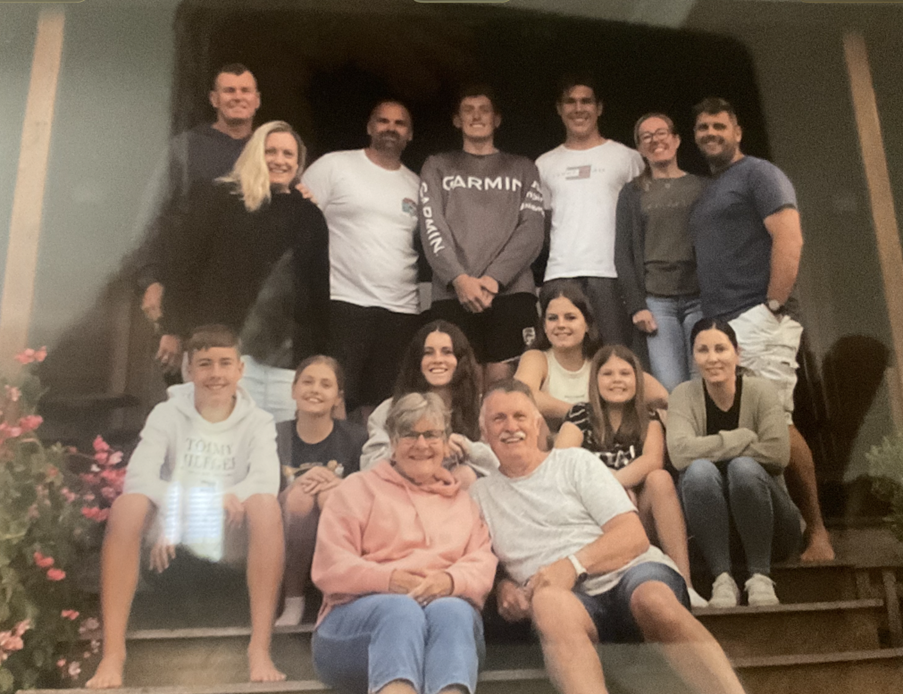
Rhonda and Chris (front row) with their children and grandchildren on Norfolk Island celebrating their 50th wedding anniversary, 2022.
I spent three months doing up the house. It was a riot of colour with purple carpet with swirly patterns and pink and yellow walls. I installed parquetry floors (of course), updated the kitchen, and painted the walls a more neutral colour.
I was only 58 years old, but too old to get a job in the flooring trade. Even though I didn’t have any experience, I decided to apply for a job as a bartender at Westport (lawn) Bowling Club. I had never worked in hospitality and I was one of the oldest applicants. My family call me ‘have-a -chat’ and the recruitment team noticed my good people skills. I had four interviews before they finally decided to employ me because I’m good at getting along with people and managing people. It’s easier to teach someone how to pull beers than to teach them social skills.
I worked at the bowling club until I was 73 years old. I’ve done everything from serving food at wakes and weddings, to calling bingo and being a barista. I was even maître de in the restaurant. For the last five years, I worked three days/week running the outdoor bar for the lawn bowls games. The club overlooks the Hastings River and is the most beautiful work location I’ve had.
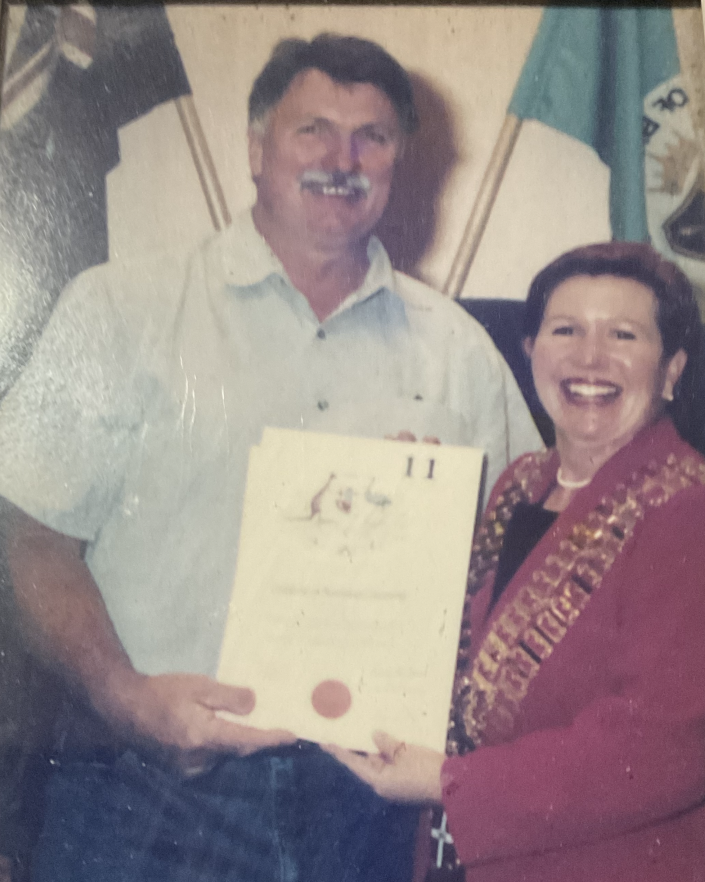
Chris receiving his Australian citizenship certificate in 2003 from the mayor of Bankstown.
Working at the bowling club was much kinder on my back than working in flooring. I was hospitalised twice in 1970s with spinal problems and am grateful to a very good physiotherapist who got me moving again. My back is a lot better now than it was in my younger years.
Rhonda and I have nine grandchildren ranging in age from 14 to 30 years. Our sons, Gavin and Trevor, are still in Sydney, as is my brother Terry. Gavin works in the flooring business, so he’s carrying on the family occupation. My dad was an amateur photographer with his own darkroom, and I’ve taken up photography as a hobby.
I often think back to what my life would have been like if I still lived in England. I can honestly say that I think coming to Australia with the BBM was the best decision I ever made. The warmer weather provides a completely different lifestyle. Terry and I became naturalized Australian citizens in November 2003.
When we lived in England, we could only afford to have a holiday once a year. We went to the same place for 15 years – a caravan owned by my Aunt Florrie near the beach in Weymouth. When we visited England with Jacqui and Trevor in 1978, we went to Weymouth and our four-year-old daughter asked if she could go for a swim in the pond. For her, a sea without waves was a pond.
I still have some family and friends in England and I still talk to a mate that I went to school with one or twice a year. I also keep in touch with James (Jim) Price who came out to Australia with me on the Fairstar and lives in Brisbane. I am grateful that the BBM gave me the opportunity to come out to the best country in the world.