

Chris Hart
Ship name / Flight number: GF(#TBC)
Arrival Date: 1/03/1967
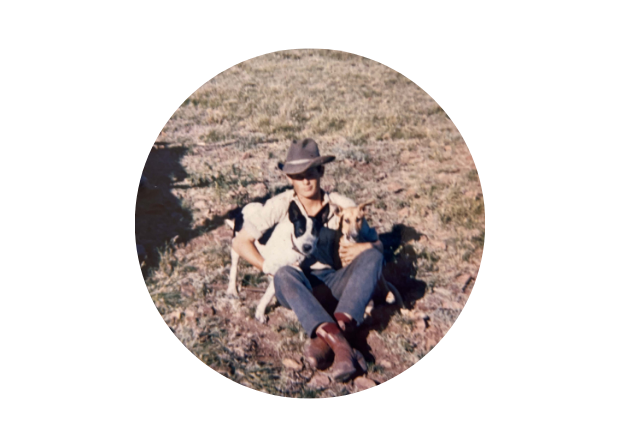
I come from a loving family, but there were some significant disruptions in my youth, which meant that we were never close. I was born in the Royal Berkshire Hospital on 16 April 1950. My parents took me home to Wargrave, a village on the outskirts of Reading on the River Thames. I lived there until I was three years old when my father bought a farm near Winchester in Hampshire. This was our family home. However, I was sent to boarding school from the age of 8, so I was only there on school holidays. I have a brother who is three years younger than me, but he was a bit dyslexic and was sent to a different boarding school.
My folks split up when I was about 12 years old, which was quite difficult for me and my brother. In the 1960s, parents didn’t really talk to children like they do now. It was a confusing time, and I felt isolated from my family at boarding school.
My father was a chronic asthmatic, so he sold the farm and moved to Portugal with his new wife where the climate was dryer and better for his lungs. He had his own agenda – we were not close.
My mother moved into a little cottage in New Forest and found a new husband. These changes happened while I was at boarding school. I came home in the holidays when I was about 15 years old to a new house, in a new place, with a new (step) father and my mother who was caring for a new baby who was 15 years younger than me. It was very unsettling.
I wanted to get away. I saw an advertisement in the newspaper for the Big Brother Movement. I’ve always had an adventurous spirit, so I applied. My Mum came to London with me for the interview at Australia House. Frank Mansell decided that I was suitable and my mum agreed to let me go. I had been riding horses on our farm and I could see myself working as a stockman on a cattle station in the Australian outback. My brother also came to Australia with the BBM a few years after me.
I flew to Australia in March 1967, just before my 17th birthday. I felt like a captive sheep in a holding pen, stuck inside a Qantas Boeing 707. We were not allowed to leave the plane when it stopped for refuelling, even when the cleaners came on board. We flew west from London to New York, San Francisco, Honolulu, Fiji and finally to Sydney. It was a hell of a long trip – over 40 hours. I remember it like yesterday. I felt like death warmed up when we made it to Sydney.
We were picked up at Sydney airport and processed (like sheep). We were taken to a farm and shown our beds in a large dormitory. I didn’t mind this as I’d been chucked into boarding school at the age of eight.
It was fun on the BBM farm – doing the milking, horse-riding, and earning our keep. I told the BBM that I wanted to work on a cattle station but I was sent to a wheat-sheep farm in central NSW. I had learnt to ride a horse on our farm in Hampshire and was used to cattle. I would cross the road to avoid a sheep (they are so stupid) but now I would be working with them.
‘Glenara Park’ was near the little hamlet of Wirrinya, 50km from Forbes. It had wheat silos, a general store, and not much else. It was at a railhead – the end of the line.
The farm was owned by Will Wilson and his wife. They had about 1000 Merino ewes and Border Leicester rams to breed Merino-Lester lambs. They also grew wheat. It was late March when I arrived and I wasn’t used to such hot weather.
Mr Wilson was an ‘Old Battler’ in his 60s who had worked hard on the land all his life. He seemed like a real Australian cocky. He took an instant disliking to me and probably thought I was a spoilt little brat with my posh English accent.
I remember that his son, Frank, ran a second family farm called ‘The Glen’. He was well-read and had a sense of humour and was nicer to me. We were on a first name basis, whereas I had to address his parents as Mr and Mrs Wilson.
I was determined to work as hard as I could to show the BBM that I was a good investment and Mr Wilson introduced me to the meaning of hard work very quickly. I spent the first hour and a half of each day mucking out the pig pens, then watering and feeding them before going to the homestead for breakfast. Mrs Wilson fed us a decent breakfast before we went out for a full days’ work. I remember it was very hot, and the lack of rain was always an issue.
It was bloody hard work. I did lots of fencing, cut down trees and learnt to drive the tractor. It wasn’t a lot of fun. I think the boss gave me some of the less desirable jobs – for example, when we were dipping the sheep, it was my job to pull the rams up the ramp by their horns. They could smell the dip and struggled. Once, I pulled too hard and went down the shoot with the ram into the dip. The boss and his son found this very funny. Fortunately, I didn’t swallow any of the revolting liquid which was a mixture of dip, poo and pee.
At the end of a long, hot working day, I went back to the homestead for a shower before dinner. However, I couldn’t soothe my aching muscles under a long, hot shower as we had to be economical with water. I wasn’t allowed to use the toilet in the house; instead, I used a long drop in the yard. These living conditions were very different from those at my posh boarding school!
I had dinner with the Wilson family in the homestead and I remember we had half a glass of sherry with our evening meal. Sitting at the dinner table with Mr and Mrs Wilson was awkward because there was not a lot to talk about.
I worked 6.5 days/ week with Sunday mornings off to go to church. I earnt very little money, but there was hardly anything to spend it on, so it went straight in the bank. Every few month there was a barn dance at a local shearing shed. Someone played a fiddle and someone else played an upright piano. The girls would sit on one side of the room and the boys had to cross the floor to ask them to dance. It the walk of death! I only went to two or three dances; there was not a lot of time for fun.
The general store in Wirrinya was run by a Catholic man who had seven daughters. I quite fancied one of them – Denise – and I managed to take her out once or twice, but the boss kept me very busy, so, alas, it didn’t progress.
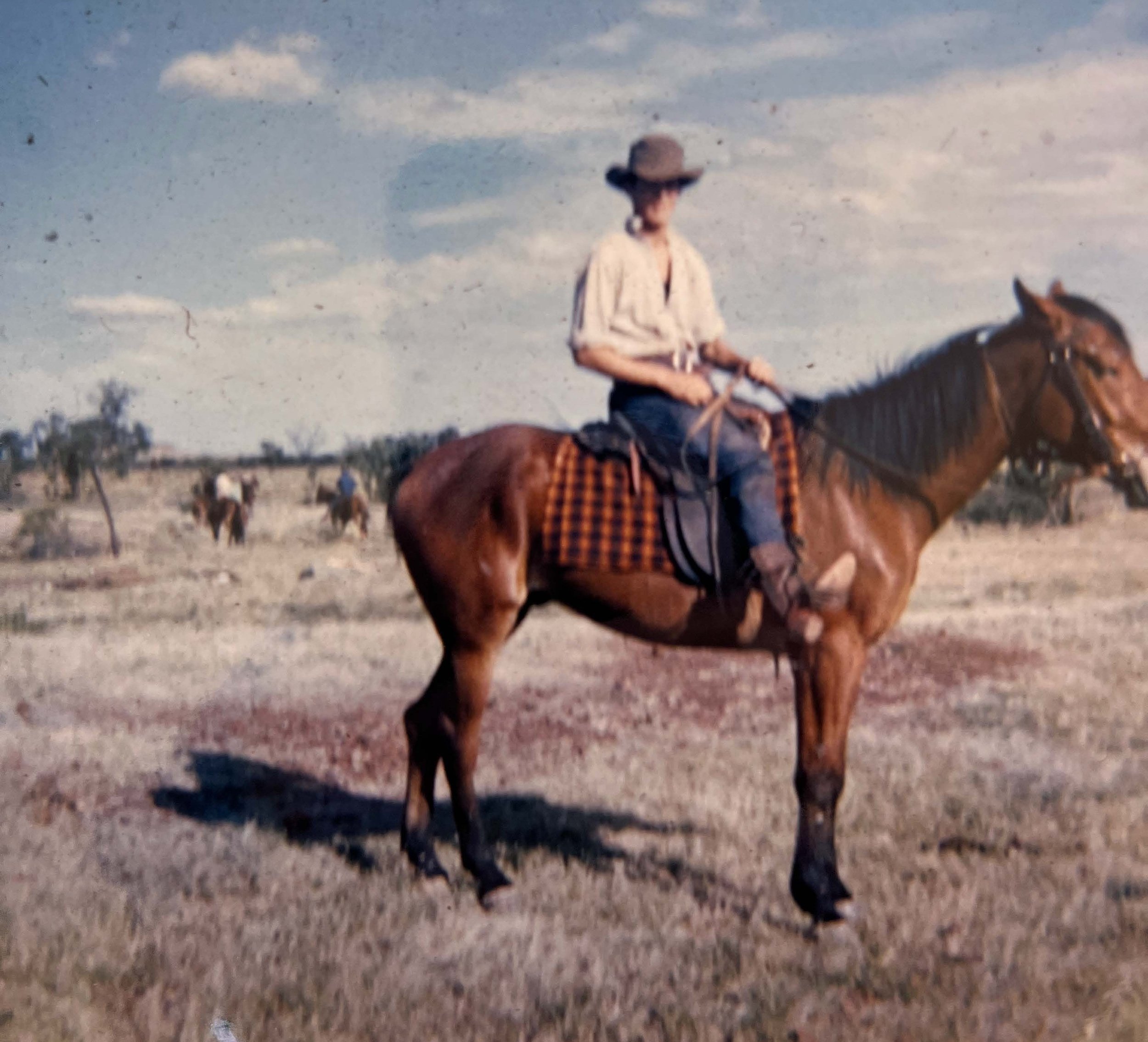
On a horse at Nicholson station, 1968
I did my very best, but Mr Wilson still didn’t respect me. By December, he had decided that he didn’t want me anymore. He accused me of leaving a gate open, causing a bull to run into a paddock, but this was complete rubbish.
I took the train back into Sydney; in some respects, it was a relief. Fortunately, my aunt contacted some friends that she had in Australia and they took me in for the Christmas of 1967.
I contacted the BBM and they suggested that I get in touch with Vestey’s, a British company with some huge cattle stations in northern Australia. I had an interview at their main office in Sydney and the pastoral manager offered me a job as a jackeroo at Nicholson Station in the Kimberleys. I couldn’t jump at the job fast enough.
Vestey’s organised for me to fly there, via Adelaide and Alice Springs. I had to spend a few days in the Alice Springs hotel waiting for the bush airline, Conellan, and apart from a few mouthfuls of sherry with the Wilsons, had never really been introduced to alcohol. Some Aussies who were propping up the bar took care of that. Without meaning to, I got very, very drunk – it was my first real hangover.
On the flight to Nicholson Station in a Beech Twin Bonanza, I sat up the front in the cockpit with the pilot and thought: ‘My God, this is fantastic. I wonder if I could ever do this’.
Nicholson was one of the biggest Vestey’s stations – it was as grand as ‘Glenara Park’ was small. There was a dining room, cookhouse, huge general store for clothing and supplies, book-keepers, welders, mechanics, blacksmiths, engineers, and a handyman. The station was like a small village and it was very well run. I was introduced to the station manager, Len Hill, and always addressed him as ‘Mr Hill’. He had his own house with his wife, children and governess. I shared a room with another jackaroo.
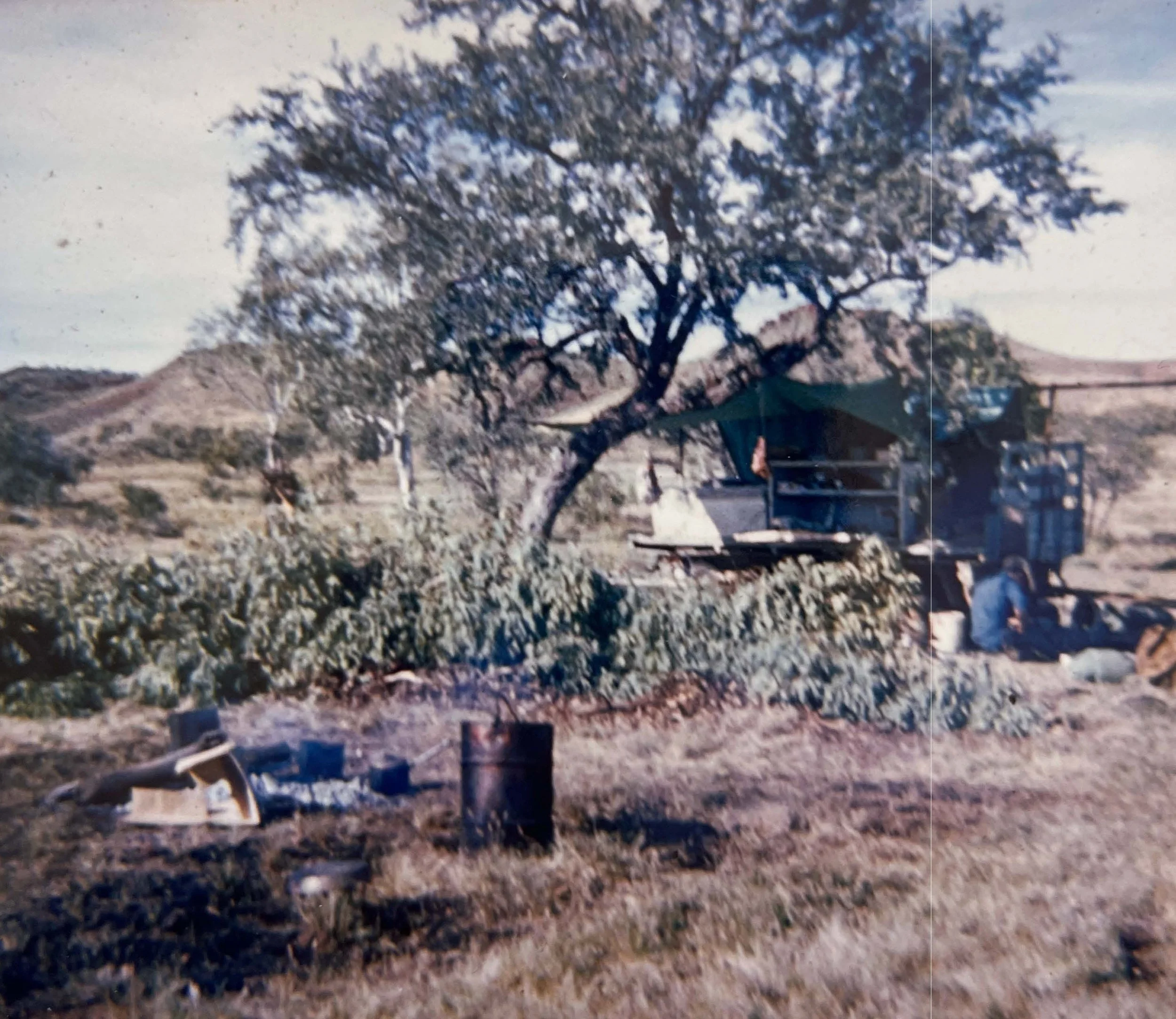
One of the camps when we went mustering on Nicholson station, 1968.
There was an Aboriginal settlement about 300 to 400 metres away from the main station buildings. Nicholson Station employed between 25-30 Gurindji people, about 10% of the local population, who were given meat, basic foods and a small wage for working as stockmen, and in the kitchen, laundry and garden. (The year before I arrived, the Gurindji at Vestey’s Wave Hill Station in the Northern Territory started a ‘walk off’ and refused to work until they were given equal wages and land rights. It didn’t finish until 1975 when a portion of their land near Watty Creek was returned to them. Some jackaroos from other Vestey’s stations had to be sent to Wave Hill to fill the gap left by the Gurindji stockmen).
I worked as a jackaroo, mustering cattle. I arrived during the dry season so I wasn’t at the station long before I was sent on a muster. We would go out on horseback for three to four weeks at a time with 12 to 14 Aboriginal stockmen. We would load up a buggy with supplies and swags, horse shoes for the horses and then disappear into the far-flung corners of the station to bring in the cattle. There were huge yards built in various parts of the station and we would muster the cattle into these fenced yards, brand the clean skins, and separate out the bullocks. Once we had enough cattle together, we’d drove the cattle back to Nicholson Station where there were huge yards. I could see the road trains coming for miles due to the dust they created. The cattle would be loaded onto one of the three trailers on the road trains to go to the abattoir, possibly in Mt Isa. Then we’d take the shoes off the horses and give them a rest.
In the wet season we repaired fences, broke in horses and did general duties around the station. I really liked it. It was an extraordinary experience for an 18-19 year old.
We had incredible responsibility. We used to shoot brumbies, wild donkeys, and camels in the bush. We would bait the dingoes. It was exciting working with horses, branding the cattle and being part of this huge operation. The head stockman was only five to six years older than me and was a first-class horseman. It felt as though nothing was impossible: ‘no’ didn’t exist in his vocabulary.
I think Australian country people are some of the best, hard-working, amazing people I have ever met. They are honest and moral and if there’s work to be done, they just do it, there’s no farting around or clock-watching. It was a very good introduction to the definition of ‘hard work’.
(Working as a jackaroo is very different today. They muster with helicopters and quad bikes. Vestey’s have sold all their big Australian stations.)
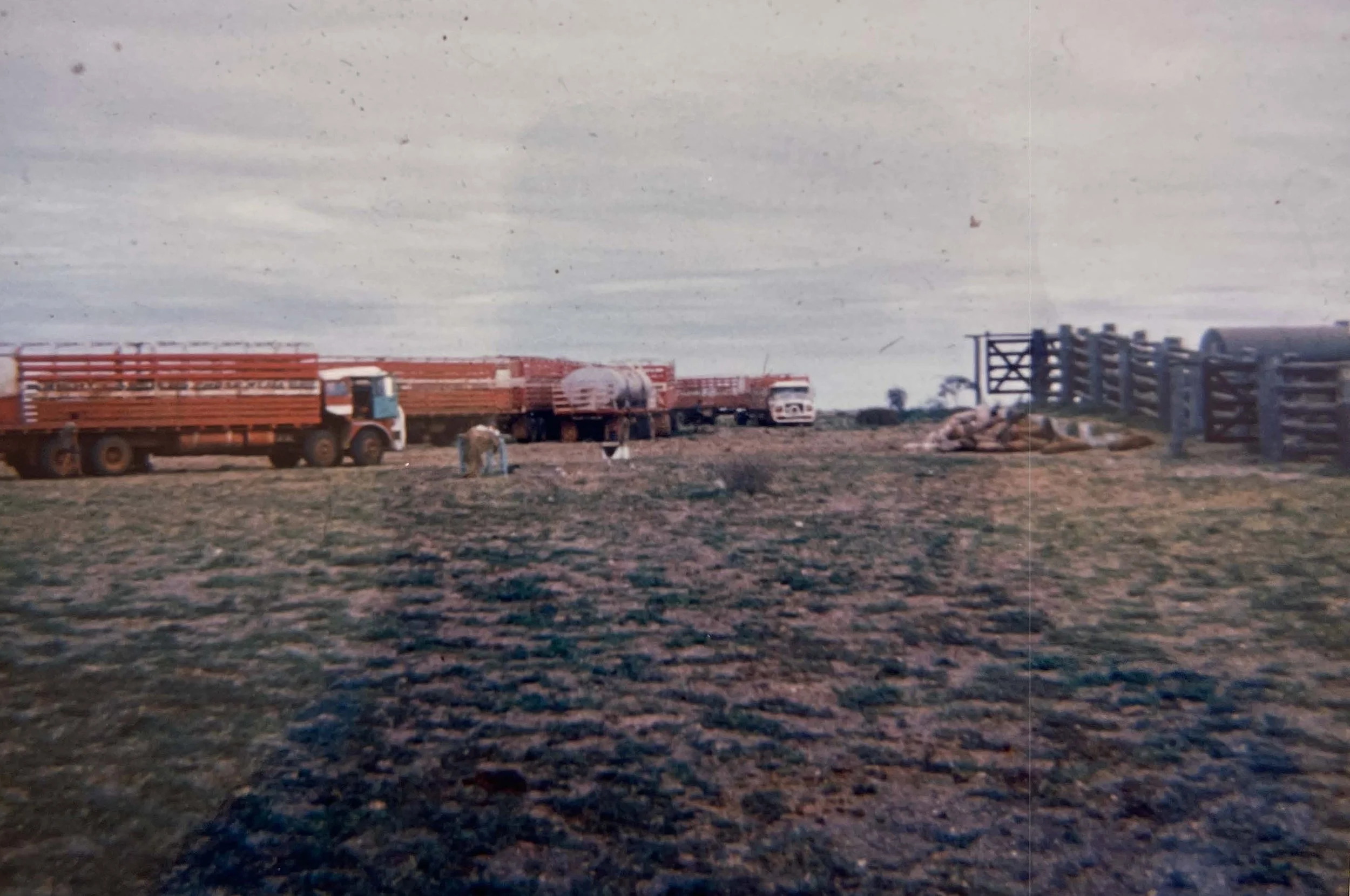
Road trains ready to be loaded with cattle, 1968.
Every year, Vestey’s would host the Negri Picnic Race meeting at Nicholson Station. Managers and jackaroos from the other stations would arrive in their 4WDs. MacRobertson Miller Airlines (MMA) would fly in a DC3 loaded with grog. It was a week of merriment, BBQs and getting pissed. There was a rodeo, horse races and gambling. Of course, you can’t have an Australian get together without a punch-up. It was quite wild, but a good time was had by all. It must have been held at the end of the dry season after the mustering was finished.
On the rare occasion when we had two or three consecutive days off, we would go to ‘town’. Halls Creek was the nearest thing to a town and it was about 130 miles south of Nicholson. We would load up the land rover with water, supplies, and wallaby jacks. Invariably we’d get bogged trying to ford a creek and need to use the wallaby jack to hoist up the car so we could dig our way out.
Once we made it to Halls Creek, we’d go to the pub and drink with the locals, including the policeman. They had Swan Lager on tap. Nicholson was a dry station (apart from the Negri Picnic Race and Christmas Day) so this was our chance to let loose. There was no such thing as closing time. In the best Australia tradition, you’d drink until you fell out of the pub.
My mum was a great letter writer and I wrote to her about once a month. We wrote on that thin airmail paper that folded into an envelope. My father didn’t write much; I didn’t have a lot of contact with him.
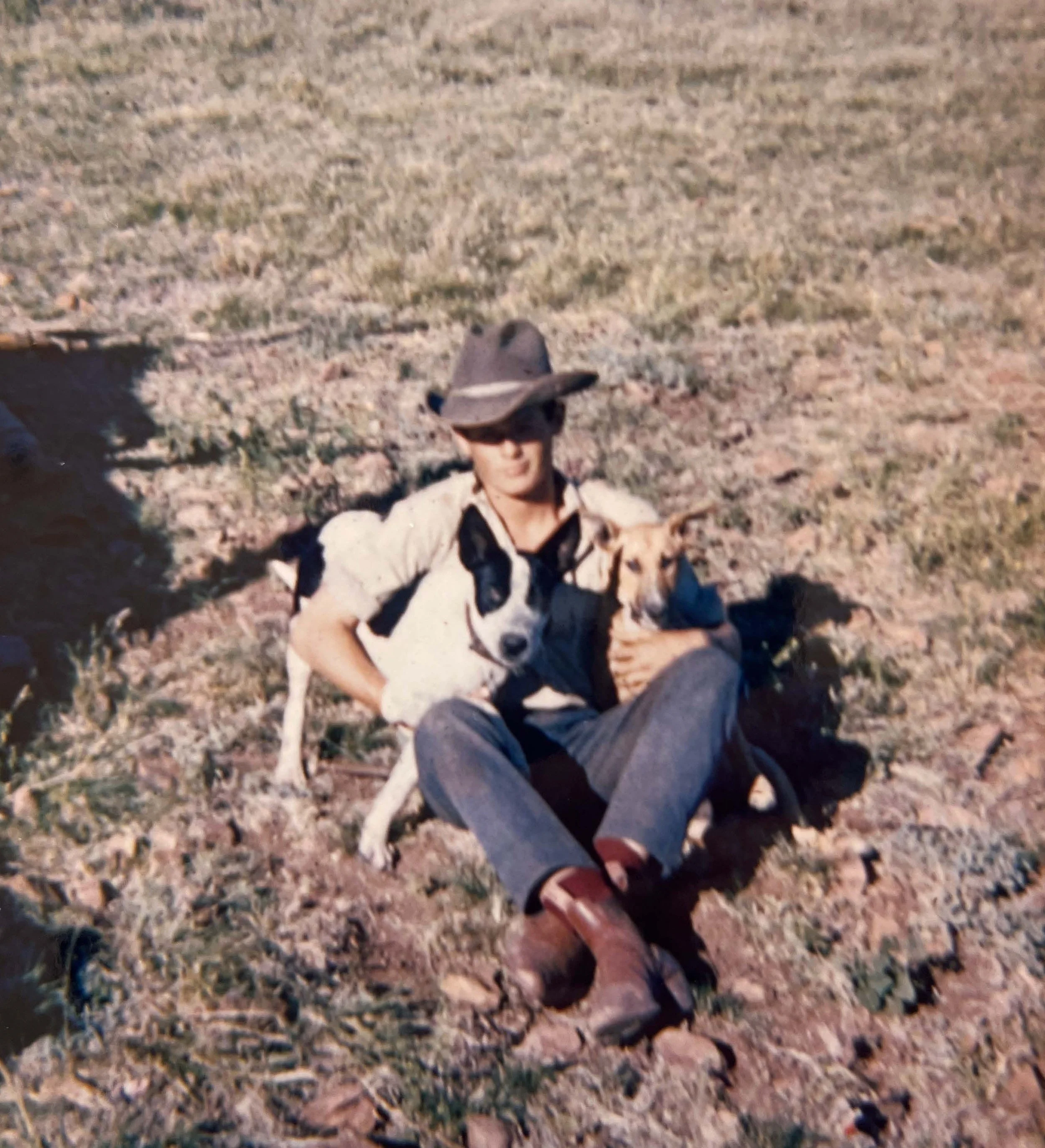
With Banjo and Buster on Nicholson station, 1968.
In 1969, as much as I loved being there and loved the people I worked with, I decided I’d like to go back and see the folks. I had saved quite a bit of money at both Glenara Park and Nicholson Station because I had nothing to spend my pay cheque on.
Vestey’s was a big worldwide organisation. They made leather and woollen products: nothing was wasted from an animal. I contacted Vestey’s head office at Union International in West Smithfield, London and when I told the personnel manager that I had been working on one of their cattle stations in Australia, he said I should go up to the 5th floor to meet Lord Vestey himself. I was ushered in, and we chatted for a while. He recommended that I take up a traineeship in business management with Vesteys. Over six years, I would be trained in the business of fell-mongering at tanneries in France and northern England and then return to Australia to run a business there. I thought this sounded pretty good so I took up his offer.
I worked in Retford, Nottinghamshire, (which had more pubs within half a mile of the city centre than any other town of England) for the rest of 1969 learning all about fell-mongering – how you remove the wool from the pelt, how you treat the pelt – and then I moved to a tannery in Mazamet, France, on the Tarn River. The water there was very pure, until it went through the tannery. Finally, I went to a big tannery near London to see some of the finishing techniques and making leather products. By the end of my training, I knew the process for turning a skin into leather goods.
At the beginning of 1971, I moved to Adelaide to a dry skin works at Jet’s Cross. There used to be a huge cattle and sheep market in Gepps Cross. While I was in South Australia, I celebrated my 21st birthday on 16 April in the Barossa Valley – drinking Barossa Pearl, a sweet sparkling wine.
Then Vestey’s moved me to a meatworks in Footscray, Melbourne, across the road from the Flemington racecourse. I had saved a lot of money while working and training with Vestey’s and instead of betting it on the horses or spending it at the pub, I went to the Moorabbin airfield and tried an instructional flight. I thought, ‘my god this is fantastic!’ I continued my job with Vestey’s but spent my weekends learning to fly and got my private pilot’s license. It was wonderful to discover that I had an aptitude for my new passion: flying.
I decided that my future was in a cockpit not a tannery and started looking around for commercial pilot opportunities. I had to tell Vestey’s that after doing their business management training for two years; I didn’t want to continue.
I made an appointment to see the general pastoral manager in Sydney and told him my decision. He wasn’t happy and said that they had invested money in training me. I felt like I’d earnt the money I’d been paid. I can’t recall how it ended, but they let me go.
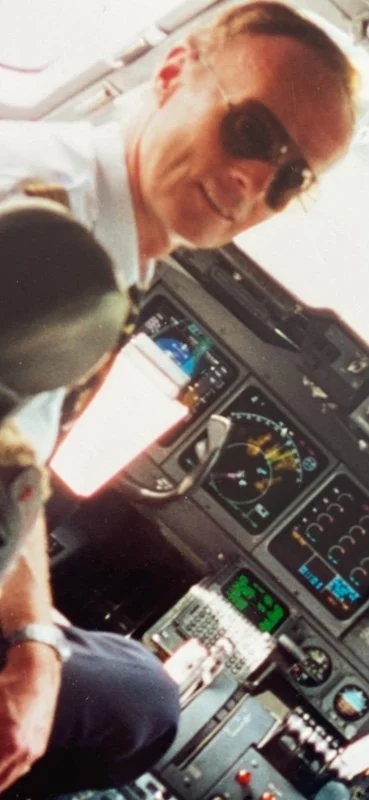
In the cockpit of a MD11, on a Swissair flight from Zurich to Osaka, 1999.
I went back to the Royal Aero Club in Melbourne where I had obtained my private pilot’s license and asked to join their commercial pilot’s course. I didn’t have a leaving certificate from an Australian high school, but I had passed the Common Entrance Exam to my English boarding school and passed my O levels. I didn’t finish my A levels because I didn’t see myself going on to university when I was 16 years old.
The Aero Club not only accepted me into their course, they offered me free accommodation in a place known as ‘the caves’ under their Aero Club bar at Moorabin, provided I did my commercial training with them. I did a couple of months of theory classes at Moorabbin and by the time I was 22, I had my commercial pilot’s license and twin-engine rating.
I wanted to join Qantas as a cadet pilot but my timing was off. Qantas had just started buying jumbo jets and each of these big birds would replace two 707s. Qantas cadet pilots were being furloughed and I knew that I couldn’t compete with them for jobs. I still had some funds left over, so I decided to go back to the UK to get a British pilot’s license at the Oxford Air Training School. I was lucky that I was learning to fly before the first big fuel ‘crisis’ in 1973 when the cost of fuel, and consequently the cost of getting a pilot’s license, sky-rocketed.
Once I had my British commercial pilot’s license I wrote to lots of companies asking for work and was finally offered a job in Dar es Salaam, Tanzania. However, I had to pay to get myself there. Once I’d worked for the company for at least six months, they promised to pay for the cost of my airfare back to London.
I spent a year in east Africa, getting experience as a commercial pilot and flying some amazing routes. When I returned to the UK in 1973, I qualified as a captain and started working for a small airline which was based in Luton. We flew to Khartoum, Sudan, with passengers in the summer and freight in the winter. After that airline went broke, I got a job flying jets around Europe with a tour company.
I really wanted to work for a larger airline and Swissair was hiring first officers. I flew to Switzerland to go through their rigorous selection process of health checks, psychometric tests, aviation theory and flight simulations. I completed the recruitment process in English, but when a slim envelope arrived with a Swissair logo on it, the letter was written in German! I couldn’t read German at that stage and had to find someone who could translate it for me. It was like winning the lottery to be offered a job with one of the best airlines in the world.
I worked with Swissair from 1979-2001 and I loved it. Working in Switzerland as a pilot for one of the world’s leading airlines was quite something, especially for a former Little Brother! I learnt French and German and flew all over the world.
After a series of bad investments, Swissair went bankrupt in 2002, but I left just before there were a lot of unemployed, highly skilled pilots flooding the job market. I flew jumbo jets for Korean Air as a contract captain until 2012.
I left Korean Air when I was 62 years old to join Pacific Blue, which was part of Virgin Australia and based in Auckland, New Zealand. I flew as a captain to all the islands in the Pacific and across the Tasman from 2012-2018. Kiwis earned less money than Australians, but had much more interesting flying routes.
I decided to retire at the age of 68 years to my home in Hawkes Bay. However, the local air ambulance service was looking for a pilot, so I worked with them until COVID hit. By then I was 70 years old and in the ‘high risk’ age group for getting very sick with COVID, so they said they didn’t want to hire me again.

My last flight with Virgin Australia in July, 2018, flying from Brisbane to Auckland.
I came to settle in New Zealand due to my love of vintage aircraft and a very rainy day. While I was working for Swissair, I was flying old bi-planes on the side, for joy flights and airshows. There was one Kiwi pilot employed by Swissair who was also into vintage aircraft. In 1997, he invited me to come to New Zealand with him because he was involved in making a documentary about the 50th anniversary of the New Zealand Aircraft Corporation (NAC). I’d never been to New Zealand, and I was still keen on an adventure, so I decided to go and fly one of his old bi-planes. I was only there for a week and on the final day we were grounded by a day of heavy rain in Palmerston North. We went to a restaurant, and I saw a good-looking woman at the bar. I went over to say hello and I’m still married to her! The following year, I bought a house in Hawkes Bay, New Zealand. I was able to organise my roster with Swissair to get time off and cheap airfares to travel to Hawkes Bay and spend a few months with her each year. She had two children from her first marriage, and I have four children from my two previous marriages in Europe, so neither of us wanted any more kids.
I have children and grandchildren spread around the world (Texas, London, France) and spend a fair part of the New Zealand winter visiting them each year. Fortunately, I’m used to long-haul flights!
I stopped flying vintage airplanes about two years ago, but I have a share in a small 4-seater plane with all the modern instruments. I still fly, but only to an altitude of 9000-10,000 feet where I can appreciate some spectacular scenery.
Retirement can be challenging when you’ve had such an active life and done lots of travelling. I have taken up mountain bike riding using a bike with a little electric motor. It’s a good way to see more of this beautiful country. I have done voice-overs for radio plays and a little bit of stage acting. I try to stay fit and do yoga and I don’t drink as much these days (unless I’m in the wrong company!) Our property in Hawkes Bay has a large garden that needs regular maintenance, so that also keeps me busy.
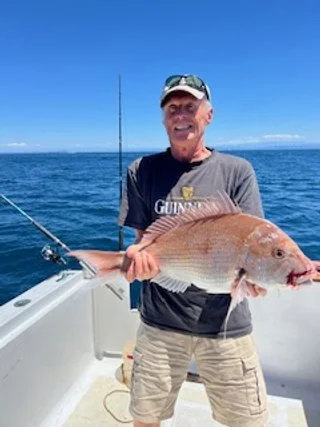
The biggest snapper I have ever caught off the coast of Napier, New Zealand, 2025
Even though I’ve settled in New Zealand, I loved Australia. There’s nowhere else in the world where I could have worked as a jackaroo while accumulating some serious savings as a 17-year-old. My life might have turned out very differently if I had been able to get a cadetship as a pilot with Qantas in 1972. I had a girlfriend in Australia and wanted to stay, but once I’d found my passion, I followed it. I shall be eternally grateful to Australia for what it gave me.
I feel fortunate to be a ‘Little Brother’, but I know it’s not for everyone. I’m extroverted, curious, and prepared to adapt to my environment. Thinking positively is awfully important, too.
My younger brother Antony (who was known as Stephen) came out to Australia about two or three years after me. He went to work on a sheep station near Julia Creek in Queensland. After two to three years he went back to the UK and joined the army. He’s not as adventurous as me and needs to be in his comfort zone. We are quite different but good friends.
When I reflect on my decision to come to Australia with the BBM when I was just 16 years old, it was absolutely the right one. It was the best thing I ever did. I grew up very quickly and learnt to think for myself. I learnt a very valuable lesson in life very early on: that you have to live with the consequences of your decisions.
Whenever I’ve been faced with a challenge in my life and I’m not sure what to do, I’ve always said ‘yes’. This started with saying ‘yes, I’ll start a new life in Australia as a Little Brother’.