

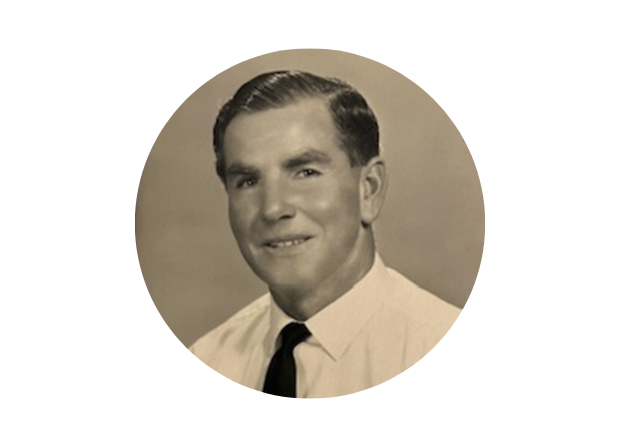
James McCraig Menzies
Ship name / Flight number: Beltana
Arrival Date: 28/05/1927
James McCaig Menzies was just 17 years old when he stepped off the SS Beltana in Melbourne on May 28, 1927, alongside 24 other young men known as “Little Brothers.” Born in Wigtownshire, Scotland, on May 14, 1910, James was the youngest of three children. His father, William McJannet Menzies, was the factor of Ardwell Estate, and his mother was Mary Agnes Lindsay McCaig.
James’s early education began at the local school before he was admitted to Christ’s Hospital in Sussex, England - a prestigious boys’ school known as “The Blue Coat School” for its distinctive uniform. It was during his final year there that a chance encounter would change the course of his life.
“During my last year at Christ’s Hospital the school was visited by Edward, Prince of Wales, who was president of the school and he was accompanied by Lord Forster, an ex Governor General of Australia. They asked any boys who were interested in Australia to come to the Headmaster’s house and talk to them. About four boys went and we sat on the floor and talked to the Prince and Lord Forster. They told us if we were interested in going to Australia to write to Lord Forster, which I did. I had a letter back saying that Lord F. was putting me in touch with Sir George Fairbairn who was the Agent General for Victoria in London. I was then given the details of an Emigration Scheme called “The Big Brother Movement”. This was a splendid scheme, if properly worked, whereby a prominent citizen accepted the responsibility of a boy when he arrived in Australia and agreed to look after him and advise him on any matter that he needed to know. My Big Brother was a Scottish member of the Australian Government called Sir Thomas Paterson. When I arrived he was the Minister for Markets and Migration in the Bruce Paige Government. This was in May 1927, and I was able to spend holidays at his house, and he kept in close touch with me and though I didn’t need to call on him for much advice he was always there and I spent a lot of time with him on political trips. I had a pretty good knowledge of Australian Government at that time.”
James’s first job in Australia was at Kaladbro Station near the Victorian-South Australian border. He later worked at Barnoolut near Casterton, and then spent five formative years at Tonga Station in Mansfield under the guidance of John and Bill Twghitt Drake — an experience he remembered fondly.
After a brief return to Scotland in 1932, the Great Depression prevented him from going back to Tonga. Fortunately, the Drakes helped him secure a position as a jackaroo at Mountside Station in Winchelsea. By 1936, James had become the manager of Ellingerin Station nearby, a role he held until he enlisted in the Australian Army on October 30, 1939.
During World War II, James served in Egypt, Sri Lanka, and New Guinea, rising to the rank of Captain. In 1943, after being injured at Wau in New Guinea, he was transferred to Heidelberg Repatriation Hospital in Victoria. There, he met Kathleen Carew Gardner, a nurse who would become his wife. They were engaged in May and married in June of the same year.
After his discharge in 1944, James managed Torumbarry Estate near Echuca. Two years later, he and Kathleen were allocated a 580-acre Soldier Settlement farm in Mortlake, Western Victoria. They named it Kiloran and moved there in 1948 with their two-year-old daughter, Janet. Both James and Kathleen became active members of the Mortlake community, eventually retiring to Kilsyth in 1972.
James passed away in 1998, forever grateful for the opportunities and life he built in Australia — made possible by the Big Brother Movement.