Peter Kearsey (previously Longbottom)
Ship name / Flight number: Orion
Arrival Date: 13/09/1961
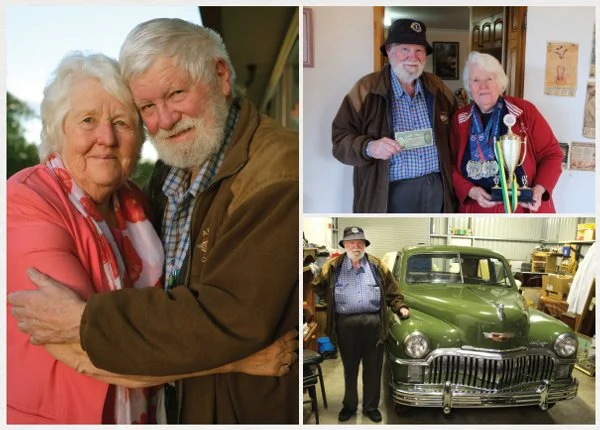
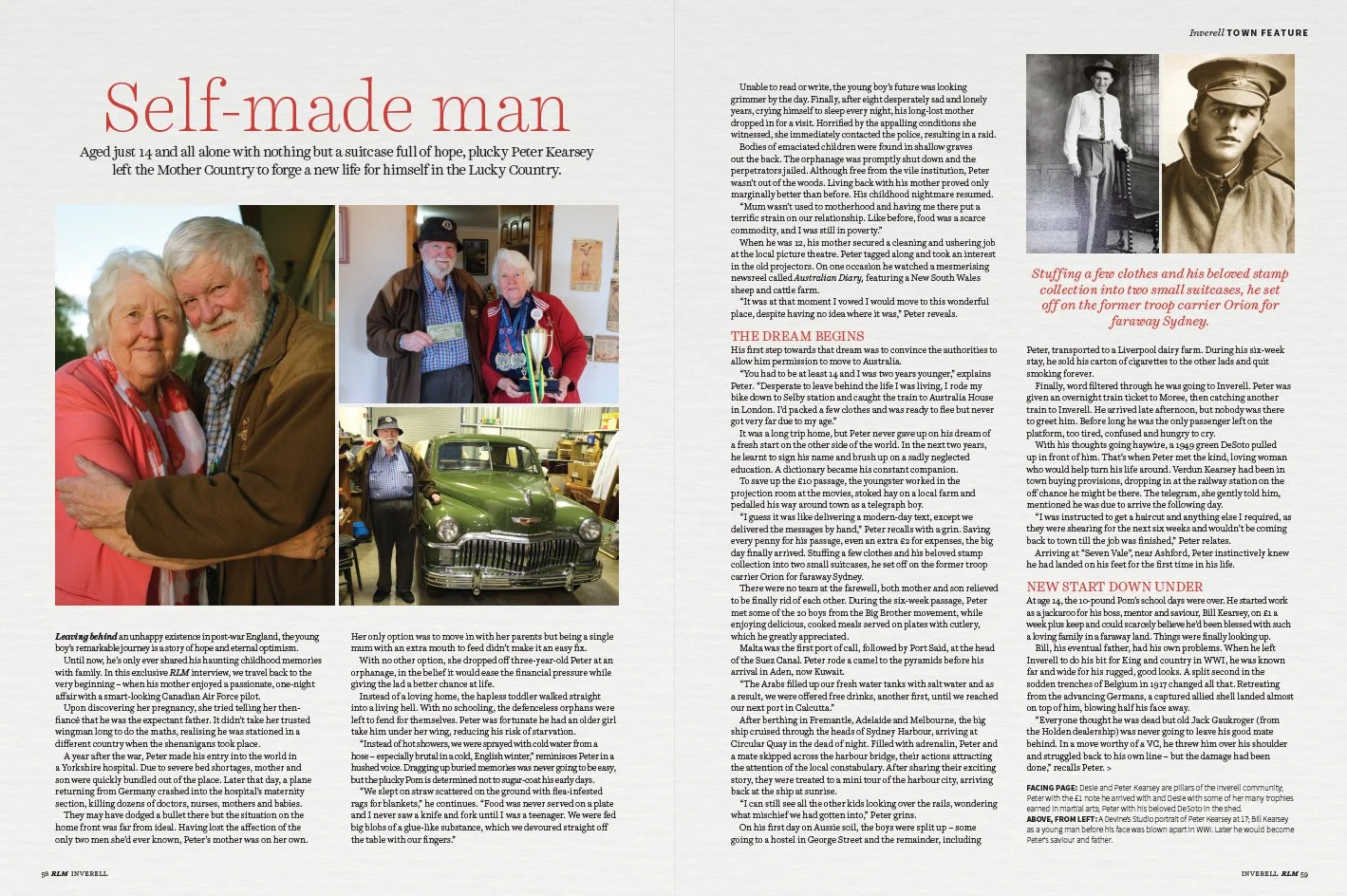
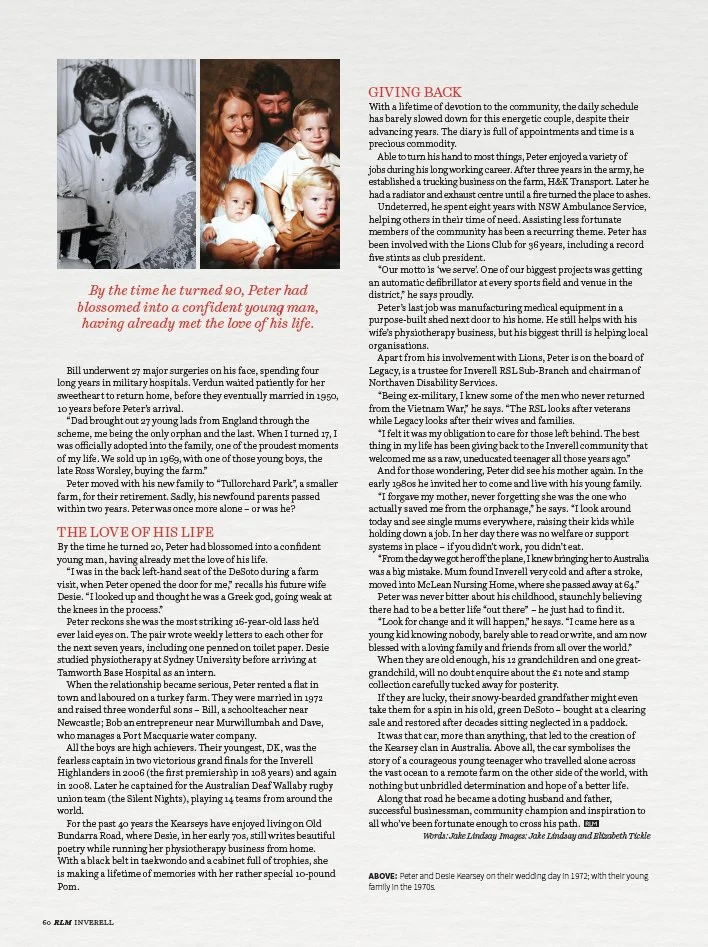
Above: Desie and Peter Kearsey are pillars of the Inverell community. Peter with the £1 note he arrived with and Desie with some of her many trophies earned in martial arts; Peter with his beloved DeSoto in the shed.
Self-made man
Aged just 14 and all alone with nothing but a suitcase full of hope, plucky Peter Kearsey left the Mother Country to forge a new life for himself in the Lucky Country.
Leaving behind an unhappy existence in post-war England, the young boy’s remarkable journey is a story of hope and eternal optimism.
Until now, he’s only ever shared his haunting childhood memories with family. In this exclusive RLM interview, we travel back to the very beginning – when his mother enjoyed a passionate, one-night affair with a smart-looking Canadian Air Force pilot.
Upon discovering her pregnancy, she tried telling her then-fiancé that he was the expectant father. It didn’t take her trusted wingman long to do the maths, realising he was stationed in a different country when the shenanigans took place.
A year after the war, Peter made his entry into the world in a Yorkshire hospital. Due to severe bed shortages, mother and son were quickly bundled out of the place. Later that day, a plane returning from Germany crashed into the hospital’s maternity section, killing dozens of doctors, nurses, mothers and babies. They may have dodged a bullet there but the situation on the home front was far from ideal. Having lost the affection of the only two men she’d ever known, Peter’s mother was on her own.
Her only option was to move in with her parents but being a single mum with an extra mouth to feed didn’t make it an easy fix. With no other option, she dropped off three-year-old Peter at an orphanage, in the belief it would ease the financial pressure while giving the lad a better chance at life.
Instead of a loving home, the hapless toddler walked straight into a living hell. With no schooling, the defenceless orphans were left to fend for themselves. Peter was fortunate he had an older girl take him under her wing, reducing his risk of starvation.
“Instead of hot showers, we were sprayed with cold water from a hose – especially brutal in cold English winters,” reminisces Peter. A hushed voice. Dragging up buried memories was never going to be easy, but the plucky Pom is determined not to sugar-coat his early days.
“We slept on straw sacks and one night, the rags for blankets,” he continues. “Food was never served on a plate and I never saw a knife and fork until I was a teenager. We were fed big blobs of a glue-like substance, which we devoured straight off the table with our fingers.”
Unable to read or write, the young boy’s future was looking grimmer by the day. Finally, after eight desperately sad and lonely years, crying himself to sleep every night, his long-lost mother dropped in for a visit. Horrified by the appalling conditions she witnessed, she immediately contacted the police, resulting in a raid. Bodies of emaciated children were found in shallow graves out the back. The orphanage was promptly shut down and the perpetrators jailed. Although free from the vile institution, Peter wasn’t out of the woods. Living back with his mother proved only marginally better than before. His childhood nightmare resumed.
“Mum wasn’t used to motherhood and having me there put a terrific strain on our relationship. Like before, food was a scarce commodity, and I was still in poverty.”
When he was 12, his mother secured a cleaning and ushering job at the local picture theatre. Peter tagged along and took an interest in the old projectors. On one occasion he watched a mesmerising newsreel called Australian Diary, featuring a New South Wales sheep and cattle farm.
“It was at that moment I vowed I would move to this wonderful place, despite having no idea where it was,” Peter reveals.
The Dream Begins
His first step towards that dream was to convince the authorities to allow him permission to move to Australia.
“You had to be at least 14 and I was two years younger,” explains Peter. “Desperate to leave behind the life I was living, I rode my bike down to Selby station and caught the train to Australia House in London. I’d packed a few clothes and was ready to flee but never got very far due to my age.”
It was a long trip home, but Peter never gave up on his dream of a fresh start on the other side of the world. In the next two years, he learnt to sign his name and brush up on a sadly neglected education. A dictionary became his constant companion.
To save up the £10 passage, the youngster worked in the projection room at the movies, stoked hay on a local farm and pedalled his way around town as a telegraph boy.
“I guess it was like delivering a modern-day text, except we delivered the messages by hand,” Peter recalls with a grin. Saving every penny for his passage, even an extra £2 for expenses, the big day finally arrived. Stuffing a few clothes and his beloved stamp collection into two small suitcases, he set off on the former troop carrier Orion for faraway Sydney.
There were no tears at the farewell, both mother and son relieved to be finally rid of each other. During the six-week passage, Peter met some of the 20 boys from the Big Brother movement, while enjoying delicious, cooked meals served on plates with cutlery, which he greatly appreciated.
Malta was the first port of call, followed by Port Said, at the head of the Suez Canal. Peter rode a camel to the pyramids before his arrival in Aden, now Kuwait.
“The Arabs filled up fresh water tanks with saltwater and as a result, we were offered free drinks, another first, until we reached our next port in Calcutta.”
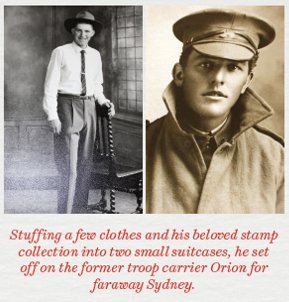
A Dewe’s Studio portrait of Peter Kearsey at 17; Bill Kearsey as a young man before his face was blown apart in WWI. Later he would become Peter’s saviour and father.
After berthing in Fremantle, Adelaide and Melbourne, the big ship cruised through the heads of Sydney Harbour, arriving at Circular Quay in the dead of night. Filled with adrenalin, Peter and a mate skipped across the harbour bridge, their actions attracting the attention of the local constabulary. After sharing their exciting story, they were treated to a mini tour of the harbour city, arriving back at the ship at sunrise.
“I can still see all the other kids looking over the rails, wondering what mischief we had gotten into,” Peter grins.
On his first day on Aussie soil, the boys were split up – some going to a hostel in George Street and the remainder, including Peter, transported to a Liverpool dairy farm. During his six-week stay, he sold his carton of cigarettes to the other lads and quit smoking forever.
Finally, world-fated though he was going to Inverell. Peter was given an overnight train ticket to Moree, then catching another train to Inverell. He arrived late afternoon, but nobody was there to greet him. Before long he was the only passenger left on the platform, too tired, confused and hungry to cry.
With his thoughts going haywire, a 1949 green DeSoto pulled up in front of him. That’s when Peter met the kind, loving woman who would help turn his life around. Verduin Kearsey had been in town buying provisions, dropping in at the railway station on the off chance he might be there. The telegram she’d sent him mentioned he was due to arrive the following day.
“I was instructed to get a haircut and anything else I required, as they were shearing for the next six weeks and wouldn’t be coming back to town till the job was finished,” Peter relates.
Arriving at “Seven Vale”, near Ashford, Peter instinctively knew he had landed on his feet for the first time in his life.
New Start Down Under
At age 14, the 10-pound Pom’s school days were over. He started work as a jackaroo for his boss, mentor and saviour, Bill Kearsey. On £1 a week plus keep and casual jobs elsewhere, he’d been blessed with such a loving family in a faraway land. Things were finally looking up.
Bill, his eventual father, had his own problems. When he left Inverell to do his bit for King and country in WWI, he was known far and wide for his rugged, good looks. A split second in the sodden trenches of Belgium in 1917 changed all that. Retreating from the advancing Germans, a captured allied shell landed almost on top of him, blowing half his face away.
“Everyone thought he was dead but old Jack Gaukroger (from the Holendale airstrip) was never going to leave his good mate behind. In a move worthy of a VC, he threw him over his shoulder and struggled back to his own line – but the damage had been done,” recalls Peter.
Bill underwent 27 major surgeries on his face, spending four long years in military hospitals. Verduin waited patiently for her sweetheart to return home, before they eventually married in 1950, 10 years before Peter’s arrival.
“Dad brought out 27 young lads from England through the scheme, me being the only orphan and the last. When I turned 17, I was officially adopted into the family, one of the proudest moments of my life. We sold up in 1969, with one of those young boys, the late Ross Worsley, buying the farm.”
Peter moved with his new family to “Tullochard Park”, a smaller farm, for their retirement. Sadly, his newfound parents passed away within two years. Peter was once more alone – or was he?
The Love of his Life
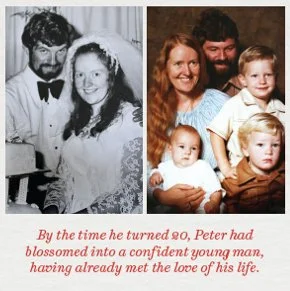
Peter and Desie Kearsey on their wedding day in 1972, with their young family in the 1970s.
By the time he turned 20, Peter had blossomed into a confident young man, having already met the love of his life.
“I was in the back left-hand seat of the DeSoto during a farm visit, when Peter opened the door for me,” recalls his future wife Desie. “I looked up and thought he was a Greek god, going weak at the knees in the process.”
Peter reckons she was the most striking 16-year-old lass he’d ever laid eyes on. The pair wrote weekly letters to each other for the next seven years, including one penned on toilet paper. Desie studied physiotherapy at Sydney University before arriving at Tamworth Base Hospital as an intern.
When the relationship became serious, Peter rented a flat in town and laboured on a turkey farm. They were married in 1972 and raised three wonderful sons – Bill, a schoolteacher near Newcastle; Bob an entrepreneur near Murwillumbah and Dave, who manages a Port Macquarie water company.
All the boys are high achievers. Their youngest, DK, was the fearless captain in two victorious grand finals for the Inverell Highlanders in 2006 (the first premiership in 108 years) and again in 2008. Later he captained the Australian Deaf Wallaby rugby union team (the Silent Knights), playing 14 tests from around the world.
For the past 40 years the Kearseys have enjoyed living on Old Bundarra Road, where Desie, in her early 70s, still writes beautiful poetry while running her physiotherapy business from home. With a black belt in taekwondo and a cabinet full of trophies, she is making a lifetime of memories with her rather special 10-pound Pom.
Giving Back
With a lifetime of devotion to the community, the daily schedule has barely slowed down for this energetic couple, despite their advancing years. The diary is full of appointments and time is a precious commodity.
Able to turn his hand to most things, Peter enjoyed a variety of jobs during his long working career. After three years in the army, he established a trucking business on the farm, H&K Transport. Later he had a radiator and exhaust centre until a fire turned the place to ashes. Undeterred, he spent eight years with NSW Ambulance Service, helping others in their time of need. Assisting less fortunate members of the community has been a recurring theme. Peter has been involved with the Lions Club for 36 years, including a record five stints as club president.
“Our motto is ‘we serve’. One of our biggest projects was getting an automatic defibrillator at every sports field and venue in the district,” he says proudly.
Peter’s last job was manufacturing medical equipment in a purpose-built shed next door to his home. He still helps with his wife’s physiotherapy business, but his biggest thrill is helping local organisations.
Apart from his involvement with Lions, Peter is on the board of Legacy, is a trustee for Inverell RSL Sub-Branch and chairman of Northaven Disability Services.
“Being ex-military, I knew some of the men who never returned from the Vietnam War,” he says. “The RSL looks after veterans while Legacy looks after their wives and families.
“I felt it was my obligation to care for those left behind. The best thing in my life has been giving back to the Inverell community that welcomed me as a raw, uneducated teenager all those years ago.”
And for those wondering, Peter did see his mother again. In the early 1980s he invited her to come and live with his young family.
“I forgave my mother, never forgetting she was the one who actually saved me from the orphanage,” he says. “I look around today and see single mums everywhere, raising their kids while holding down a job. In her day there was no welfare or support systems in place – if you didn’t work, you didn’t eat.”
“From the day we got here, I knew bringing her to Australia was a big mistake. Mum found Inverell very cold and after a stroke, moved into McLean Nursing Home, where she passed away at 64.”
Peter was never bitter about his childhood, staunchly believing there had to be a better life “out there” – he just had to find it.
“Look for change and it will happen,” he says. “I came here as a young kid knowing nobody, barely able to read/write, and am now blessed with a loving family and friends from all over the world.”
When they are old enough, his 12 grandchildren and one great-grandchild, will no doubt enquire about the £1 note and stamp collection carefully tucked away for posterity.
If they are lucky, their snow-greyed grandfather might even take them for a spin in his old, green DeSoto – bought at a clearing sale and restored after decades sitting neglected in a paddock.
It was that car, more than anything, that led to the creation of the Kearsey clan in Australia. Above all, the car symbolises the story of a courageous young teenager who travelled alone across the vast ocean to a remote farm on the other side of the world, with nothing but unbridled determination and hope of a better life.
Along that road he became a doting husband and father, successful businessman, community champion and inspiration to all who’ve been fortunate enough to cross his path.
Words: Jake Lindsay, Regional Lifestyle Magazine
Images: Jake Lindsay and Elizabeth Tickle