Ship name / Flight number: SS Strathnaver

Arrival Date: 13/03/1955
I was born 1939 in Sheffield, Yorkshire, just before the Second World War changed everything.
My father, George Samuel Scholey, was a herbalist, and had a shop where he sold herbal tonics, drinks, and cigarettes. My mother, Ethel neé MacLean, was Irish, but her ancestors were Scottish. Mum trained as a nurse and left Ireland when she was 18 years old to move to Liverpool and then Sheffield, where she met my father. I come from good Celtic stock.
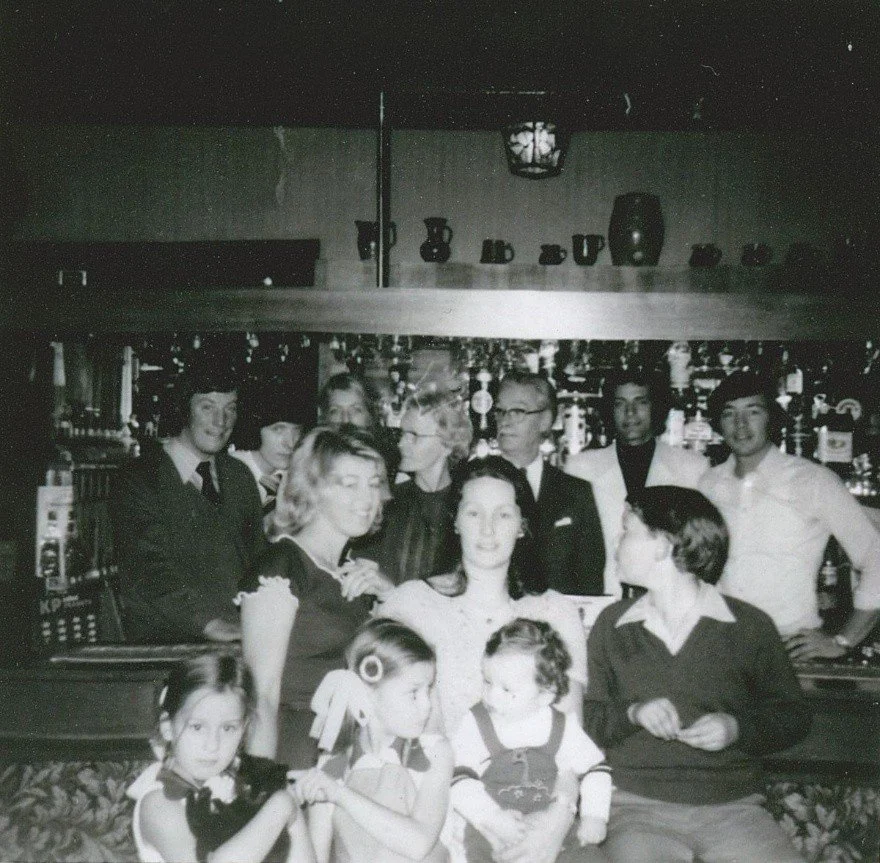
My parents were very busy with seven children born between 1934 and 1946. I have four brothers and two sisters so there was always someone to play with in the big garden around our house. My father’s mother lived with us – three generations in a three-bedroom house.
I wasn’t academically inclined and left school in May 1954 for a job at the Sheffield Telegraph and Star newspaper as a messenger boy. I read the articles in the newspaper about Australia and saw an advertisement for the BBM. Going to Australia seemed to offer more opportunities than post-war England. My oldest brother, Geoffrey, had already migrated to New Zealand but he eventually moved back to the UK.
When I was at school, I liked geography, history and reading about faraway places like Australia and Canada. I dreamed of going to Canada, building a log cabin and hunting for furs. Sailing to Australia and working on a sheep farm was the next best thing.
Mum and Dad weren’t that impressed with my plan to migrate to Australia; they wanted me to wait until I was a bit older. I told them that I’d go out and get a farm and then they could join me with the family. I also knew that I could come back within two years if I wasn’t happy. My parents said they might come out, but they never did – their ties to their extended family in England, Ireland and Scotland were too strong.
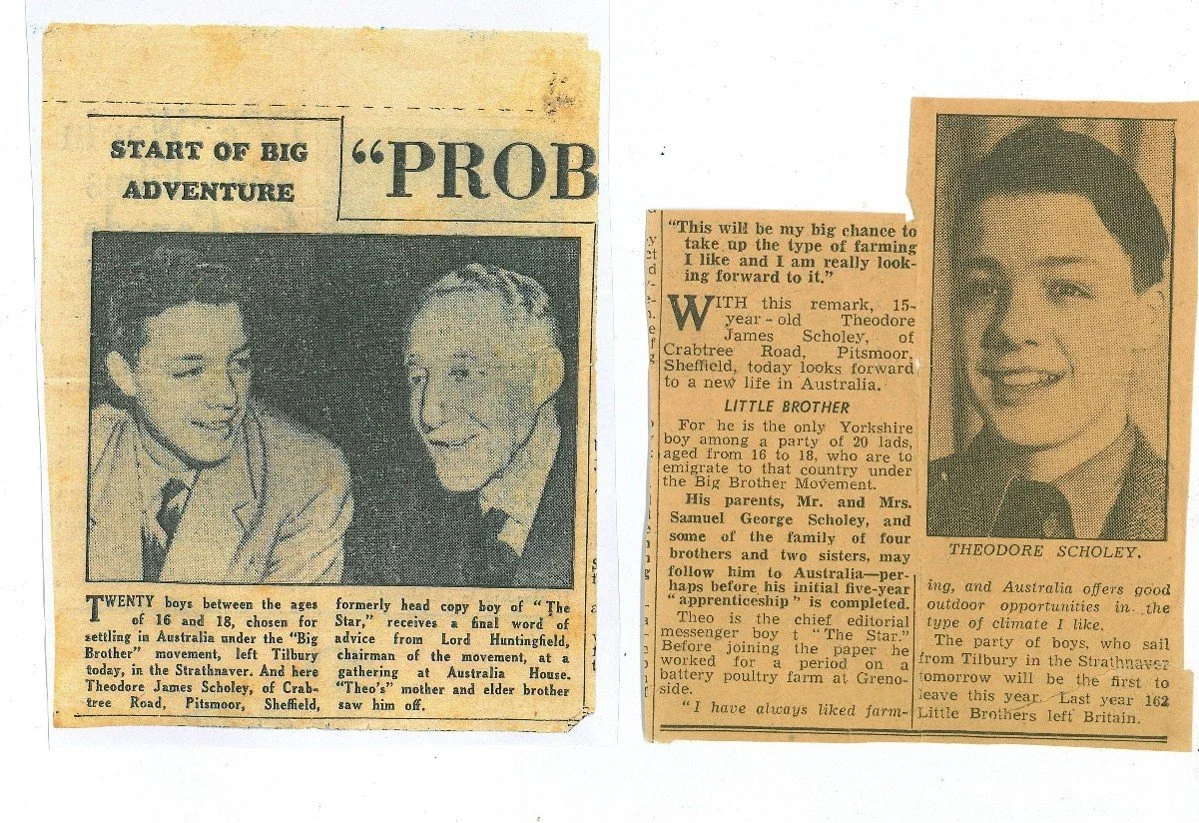
Newspaper articles, 1955
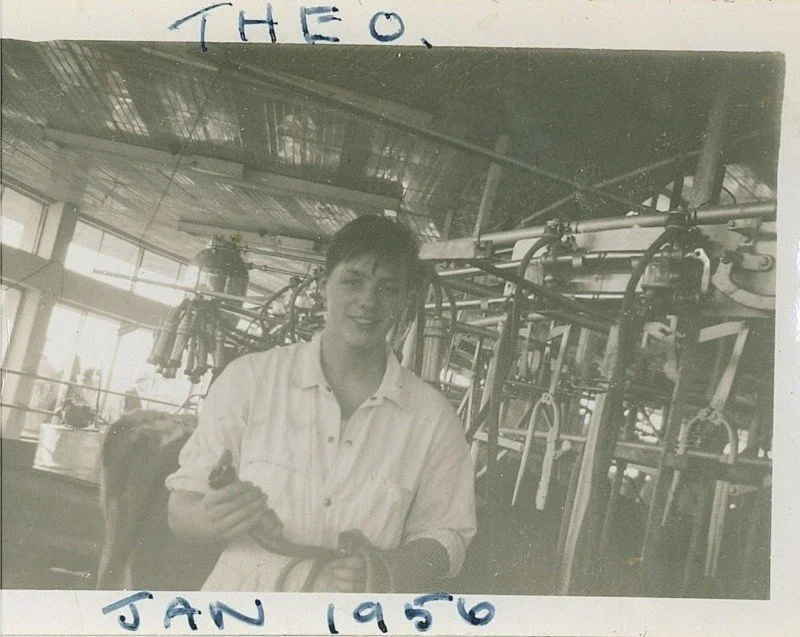
Theo in front of the rotolactor, Menangle, 1956
I came out with 19 other ‘Little Brothers’ and celebrated my 16th birthday on the SS Strathnaver as the boat docked at Circular Quay in Sydney on 13 March 1955.
We were taken to a reception place in Sydney called Parkhill(?) and then I was sent to work on the Burnett family’s mixed farm in Finley. It was a great experience going to outback New South Wales and so different to Yorkshire. However, when the weather turned very bad in July and it seemed to rain all the time, I lost interest and asked the BBM if I could move to a dairy farm.
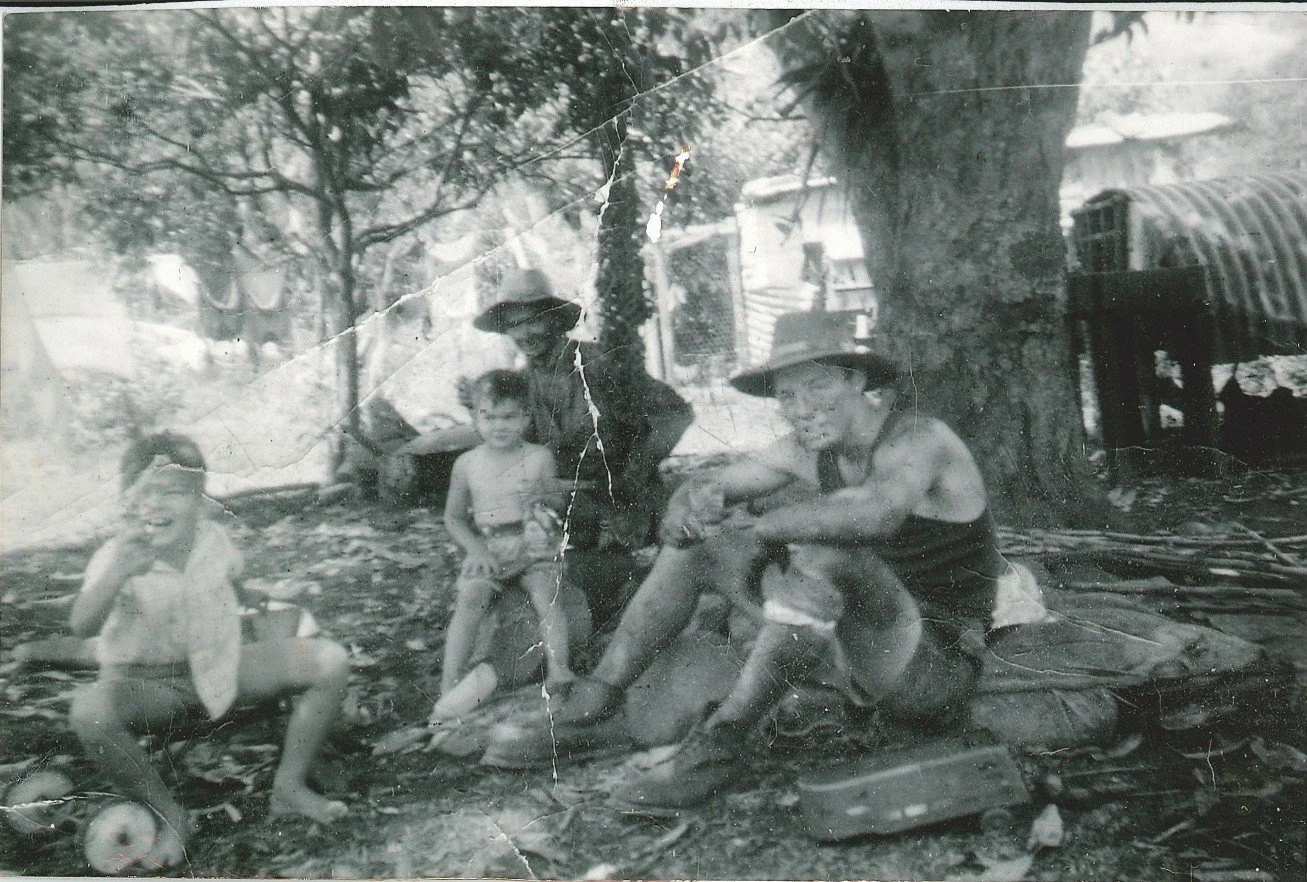
1957, having a tea break on a cane farm at Sarina, Queensland. Theo is on the right with a bandage on his leg after an accident with a cane knife. His shack (accommodation) is in the background.
I left in September 1955 and went to work at Menangle in the Camden Park estate. We used the new rotolactor milking machine to milk the cows, and the milk was sent to Sydney each day. This machine could milk a cow in just 7 minutes and process about 2500 cows per day! [see https://menangle.com.au/?page_id=524] I enjoyed working there because there were a lot of young people and my wage trebled to ten pounds a week!
After I’d been at Menangle for about nine months two former employees wanted to come back, which meant that myself and Tony (also a Little Brother) were laid off. The BBM found me a job at a dairy farm in Berry, NSW. It was the best time of my life. Winston Birdsall and his wife were like a mum and dad to me. When they went to Sydney, I was left in charge of the farm for a few days. I got myself a motorbike and felt like I had some freedom and independence.
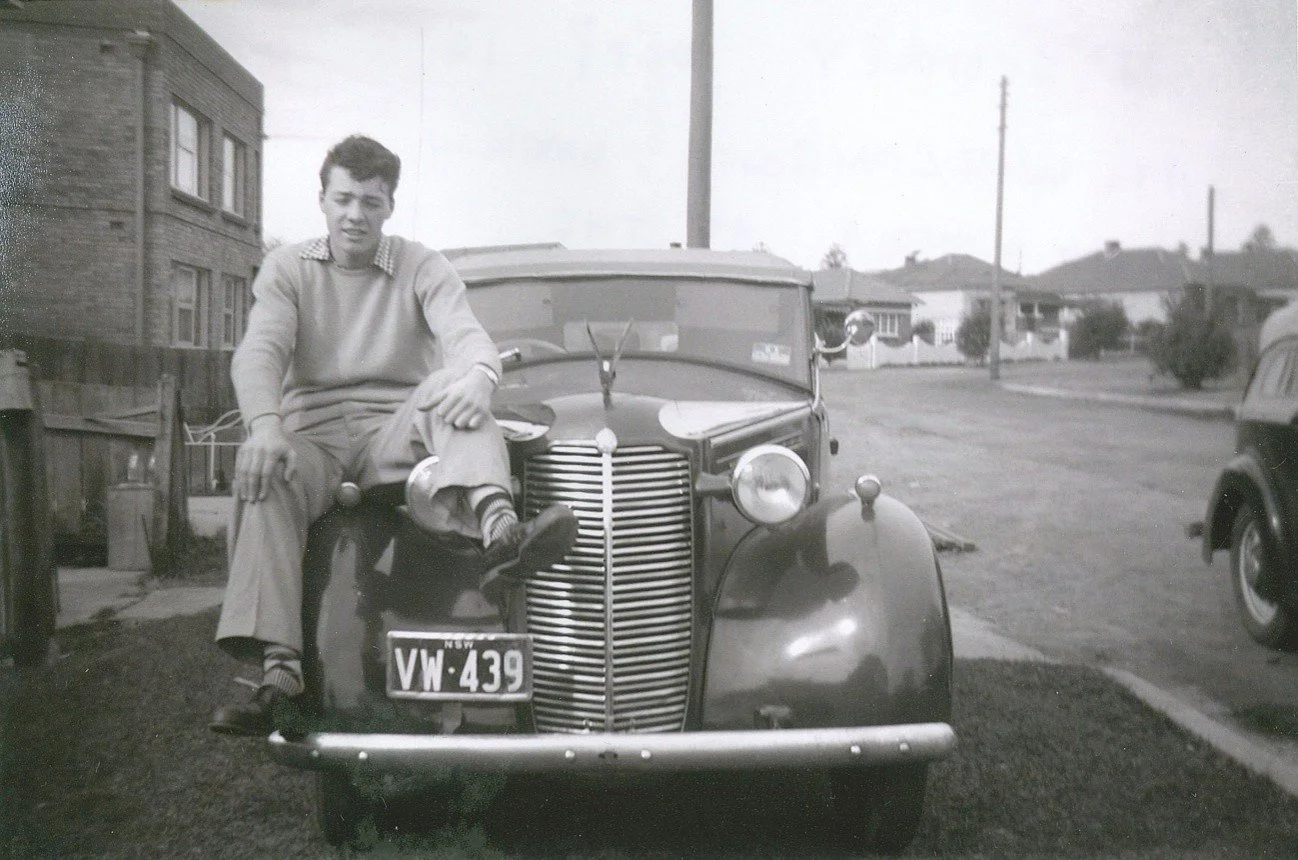
Theo in Wollongong, 1958, when he was working in Port Kembla for AIS
In July 1957, when the cows are drying off and there was less milking, Johnny Severs, a mate from the BBM, contacted me and said he was going to Queensland to cut sugarcane. I rode my motorbike up to Sarina and got a job on a small farm cutting cane by hand with a knife. The owner couldn’t attract the top cane-cutters to work on his farm because it was so small. Despite his difficulty getting labourers, after a few weeks of back-breaking work in the sun the owner told me I wasn’t cutting fast enough. I sped up so that I was cutting 14 tons of sugarcane per day and loading it onto trucks that took about two tons each. My mate Tony gave up cutting and went to work in the sugar factory.
In December, after the sugarcane season ended, I heard that there was seasonal work packing fruit near Shepparton. I sold my motorbike in Mackay, caught trains to Shepparton and found a job in a cannery in Mooroopna.
My next employer was the Australian Iron and Steel (AIS) works in Port Kembla. I worked there as a crane chaser until Arnold, one of my younger brothers, emigrated with the BBM. I rode my new motorbike to Calmsley Hills farm to meet him. We rode around Sydney for a bit until, like me, he was sent to Finley to work and I went back to packing fruit in Mooroopna.
Then our older brother, Geoffrey, joined us. He had served in the Korean War and joined me at the cannery. When the packing season was over, we went to Sydney together and worked in a range of labouring jobs. Arnold left Finley and stayed with us for a while before moving to Queensland.
I went back to the cannery in Mooroopna for another season and then worked at the butter factory in Shepperton. It was easy to pick up seasonal work in Australia in the 1950s.
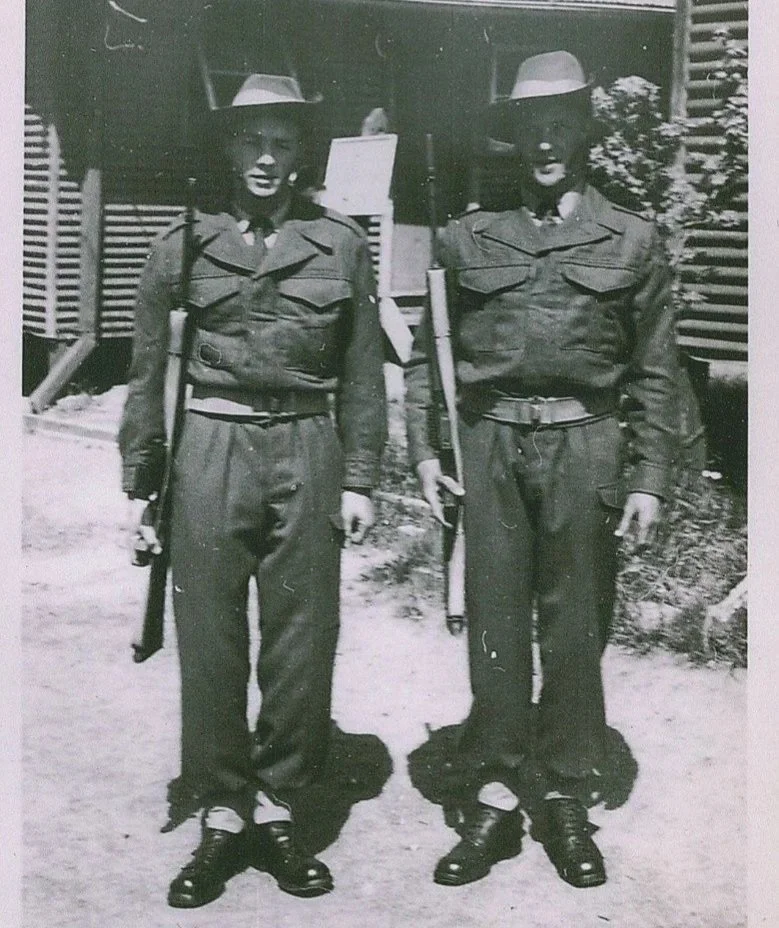
Theo on the left, age 22, 1961, Puckapunyal, Victoria.
I met Joyce through Edwina, my girlfriend. We were at a New Year’s Eve party in Shepparton, and I started dancing with Joyce who had just turned 16 years old. Her father was a dairy farmer and we all got along. Joyce and I were married in 1961 at the Church of England in Shepparton and her brother, John Dry, was my best man. Our daughters, Odette and Jacqueline, were born in 1965 and 1967. Odette is named after Odette Churchill, who was a spy for the Allies in Nazi-occupied France during World War II.
After getting married, I joined the Royal Australian Engineers, Army Reserve and trained at the army base in Puckapunyal. I was awarded the Wallace shield as the “most efficient Sapper” and best new recruit of 1961.
After five years of seasonal work, I wanted a steady job that allowed me to stay in one place, so I started working for the state electricity commission as a linesman. I was promoted to A-grade linesman after three years and worked there for the next 40 years until 1995. I was given two weeks leave year to train with the army reserve.
In 1979 I got an urge to go back to England, so we sold our house in Shepperton and moved to the ‘mother country’. We ran a fruit and veggie shop in a little place just out of Sheffield and we were just getting by. I remember one day I went into the loungeroom and overheard Jacqueline saying to my oldest daughter: “when I’m 18, I’m going back to Australia”. Odette agreed that she’d do the same. After two years we decided to come back to Australia and built a house in Aspendale, Melbourne. I went back to working with the electricity commission.
Odette now lives in the house in Aspendale. She cared for Joyce until she passed away in 2024. Joyce and I separated but remained friends.
I live in Wonthaggi in southern Victoria with my new partner, Cathy. I played golf on weekends until I was about 85 years old and my back started playing up with arthritis. Now I play indoor bowls twice a week instead. It’s a good way to socialise and gets me out of the house.
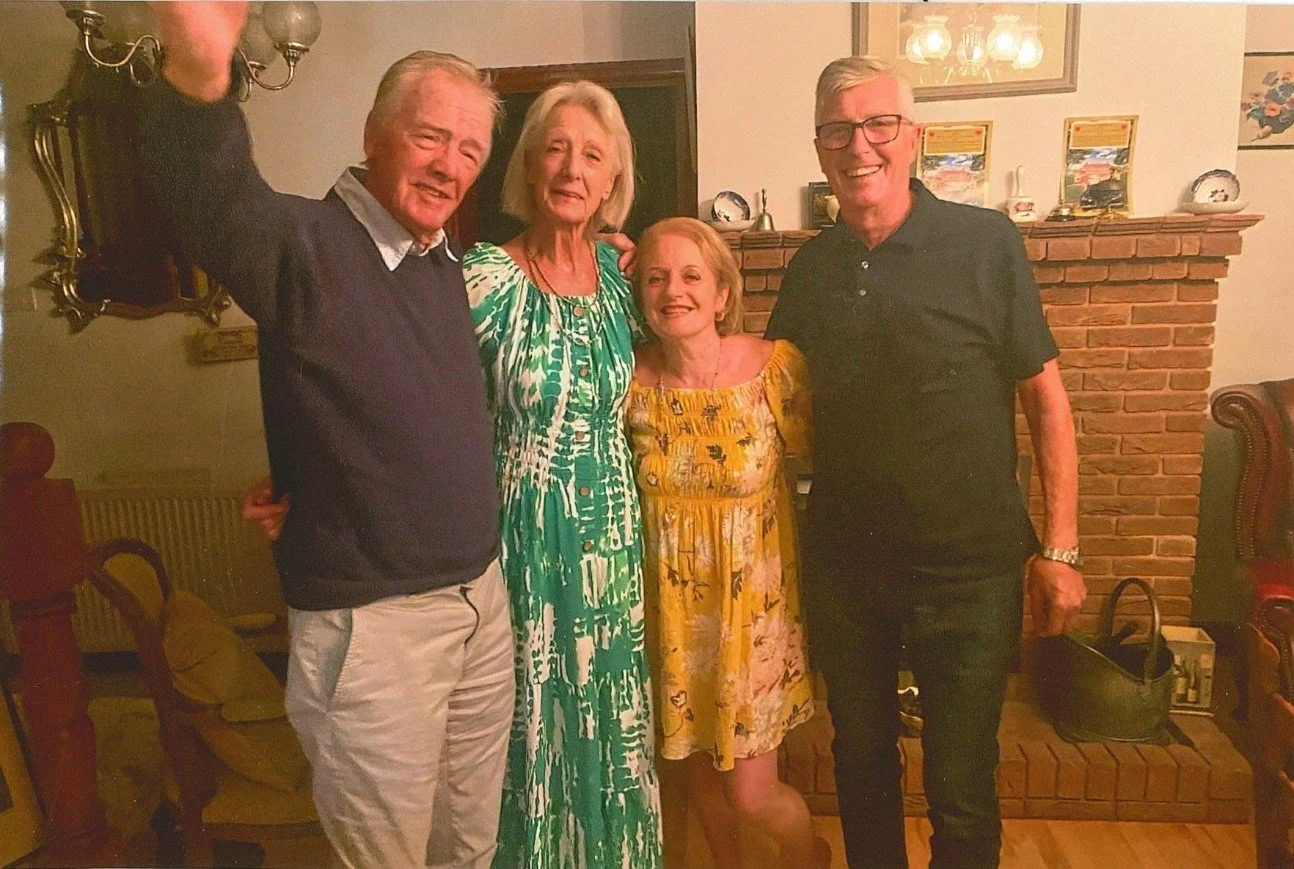
I went back to England in 2024 to visit my oldest sister who was very sick and I caught COVID19 on the flight. It was hard knowing that it was the last time I’d see her, but I am still happy that I came out to Australia. Some of my siblings emigrated – my eldest sister came out to Australia with her husband and son, but they only stayed for a couple of years and my youngest brother, Robert, also came out (but not with the BBM) for about 4-5 years.
I never became an Australian citizen, and I wish I had. Coming to Australia was the best thing I ever did. It’s a lovely country and I still love it.