

Michael Partridge
Ship name / Flight number: SS New Australia
Arrival Date: 20/09/1957
The world wars had a big impact on my family. Firstly, I lost an uncle in the First World War, so my parents were relieved that my father worked in food and agriculture, which meant that he couldn’t be conscripted. He joined the home guard in Ipswich, Suffolk, to ‘do his bit’. Secondly, I was born towards the start of the Second World War on 21 February 1940, and my parents didn’t have any more children until after the war ended. Finally, during the war, we moved north to Yorkshire, to a town called Beverley, as Dad was involved in rural food production. We lived about two miles from the end of Leconfield aerodrome, and I can remember seeing the planes take off and saying to my father: ‘Oh that’s a big plane, dad!’ He told me that the plane was a Lancaster bomber, and I later learnt that we lived next to the RAF Bomber Command airbase. After the war, in 1947, there was an open day at the Leconfield Aerodrome, and I got to sit in the cockpit. It is still my favourite plane.
Life at home with my two younger brothers was pretty plain. I went to primary school in Beverley and we amused ourselves on weekends. My dad was strict and we were expected to obey him and help out, especially when he was away on business. As the eldest boy, I did lots of work in our family’s vegetable garden. We even had a small tractor to help with the ploughing.
When I was about 10 years old, we moved to Glenmorgan, outside Cardiff, Wales. My dad sold agricultural machinery for a living and Fordson tractors were now being made in the UK and becoming more popular. Business was picking up after the war.
I didn’t like living near Cardiff – I’m not a city person. I had nowhere to go and nothing to do. I don’t like being bored with nothing to do and all day to do it. I think my parents understood this and sent me to my aunts and uncles’ farms in Suffolk where I could help out during my school holidays.
Fortunately, we moved again, which meant another new school for me. My final secondary school was in Kingsclere, near Highclere, Hampshire, which is where the popular TV show Downtown Abbey would later be filmed.
After school, my dad lined up an interview for me to work in the royal gardens in Windsor Castle. I worked there for about 18 months. I enjoyed gardening but wanted to learn more about farming, and went to Sparsholt horticultural college outside Winchester for a year. I finished my course in June 1957 and saw an advertisement in the paper for people to work on farms in Australia. My mother’s brother had gone to Canada, so I decided to apply. My parents were happy that I was going with an organisation that would meet me at the other end (of the voyage) and help me to get a job.
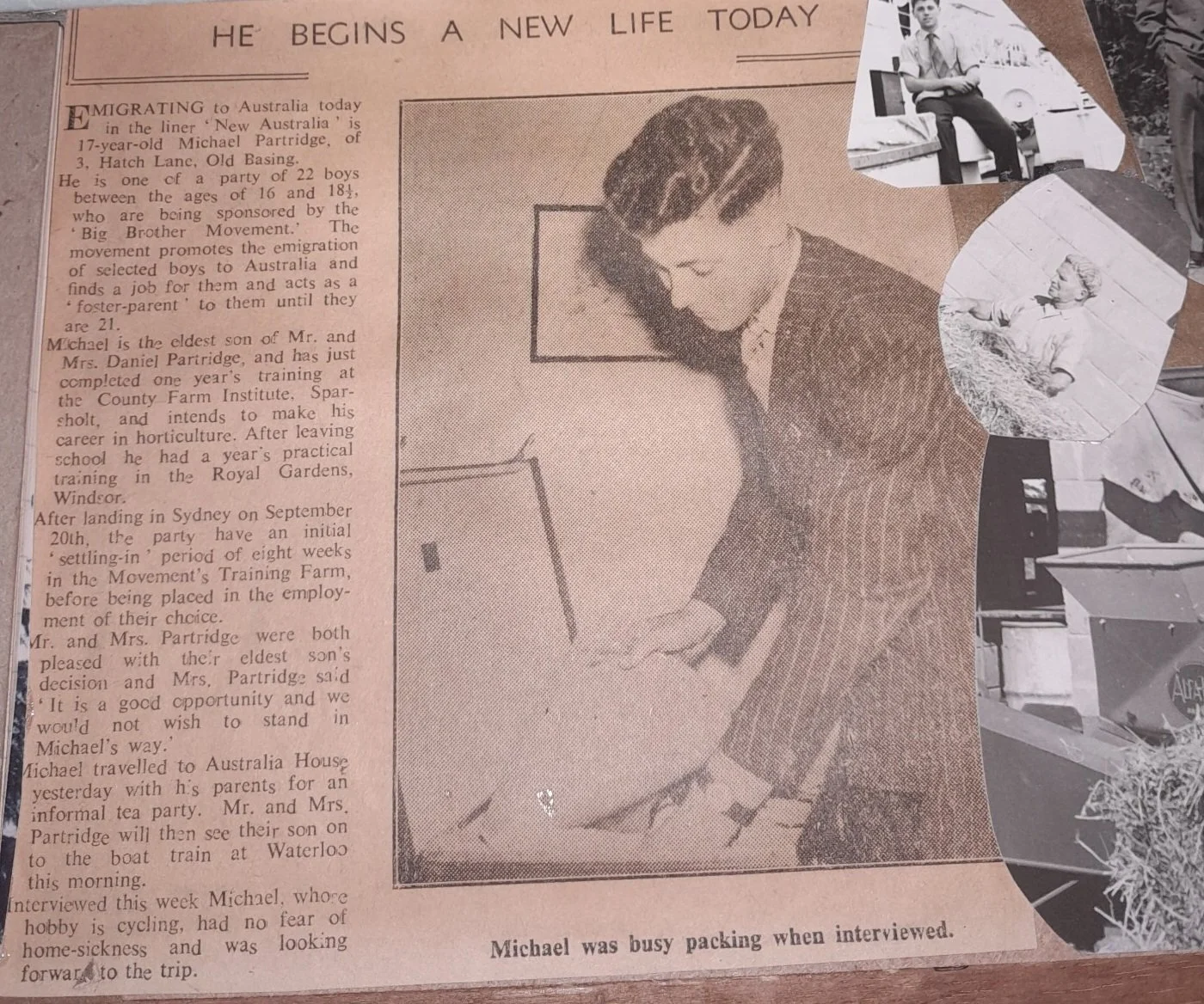
A newspaper article that I kept from 1957.
The voyage with 21 other ‘Little Brothers’ was longer than most because we sailed via the Cape of Good Hope and not through the Suez Canal. When we arrived in Sydney in September 1957, I went to the BBM farm at Karmsley Hills near Liverpool. I wanted to work on an orchard but was sent to work on a dairy farm instead! I took a long train journey to Narrandera then onto Tocumwal, with Peter Bentley another Little Brother who was also being sent to work on a farm in central Victoria.
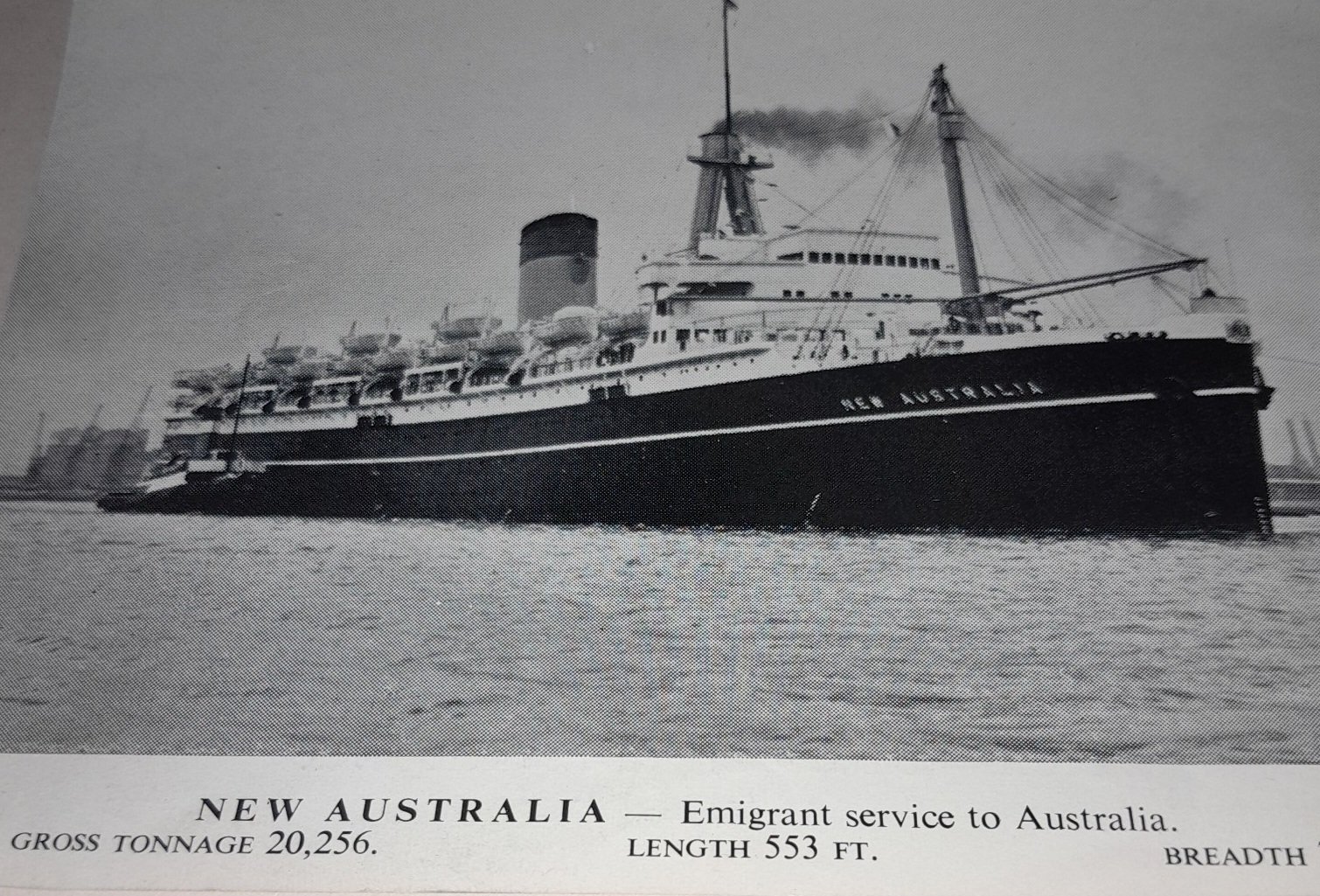
I migrated to Australia in 1957 on the SS New Australia.
I was sent to the Goulburn Valley soldier settlement area in Victoria where there were 400 dairy farms supplying the Murray Goulburn Cooperative with milk. My boss was a soldier-settler who’d been through some tough times in the war and was a tough manager. I worked 12-hour days from 6am-6pm. I only stayed for about three months.
In the same valley, there were at least 100 fruit farms supplying Shepparton Preserving Company (SPC). I applied for a job on one of these farms and was told it was a permanent full-time job, however, at the end of the picking season I was put off. I worked for an English farmer who had married an Australian and was hard as nails. I often had to work an 18-hour day but only got paid for 6.
I was getting to know some of the other soldier-settler families in the Goulburn Valley and I started doing some casual gardening work for the Carter family in Katunga. They treated me like a member of the family, which was a nice change after feeling exploited for my labour. I worked in their dairy and milked about 80 cows every morning and evening. I would also do relief milking for neighbouring farms. I enjoyed it.
Mr Carter had fought in Papua New Guinea but he never spoke about it. He had two sons, one with Downs Syndrome, and a daughter. I started to call them ‘Mum and Dad’ and was invited to their daughter’s wedding. I felt respected and included.
During this time, I corresponded regularly with my parents and by 1961 I’d saved £350, which was the cost of a return trip by boat to the UK. I enjoyed visiting my family, and my mother wanted me to stay, but I decided that I was much better off in Australia.
I sailed back on the SS Fairsky, which had another group of Little Brothers on board. I took the opportunity to tell these ‘new chums’ a few ‘home truths’ about Australia; like the vast distances between towns and how hard it could be working on large farms. I don’t know if they appreciated my candour!
I also met my future wife on the Fairsky. Joyce Barbury was in the neighbouring cabin and was migrating to Australia from Kent with her parents and two sisters. They were planning to settle in Sydney.
I went back to work on Max Carter’s farm at Katunga and would catch the overnight train to Sydney to see Joyce for the weekend. Her family were staying at the East Hills Migrant Hostel and she was working as a shorthand typist with royal exchange insurance. I stayed at the People’s Palace, which was run by the Salvation Army.
After courting for a year, we married at a Methodist church in Liverpool in October 1962. Ewen Carter, Max’s eldest son, was my best man. Joyce and I are still together more than 60 years later.
On one of my trips to Sydney, Frank Mansell from the BBM told me that he knew a farmer who was looking for someone to run a dairy in Deniliquin. It was really a mixed farm with land to grow grain and raise calves. Joyce and I took it on and some new Little Brothers were assigned to work at the dairy. One of them was John Gutridge, a Little Brother from the Isle of Wight. I can’t recall the name of another who didn’t like getting out of bed in the winter!
After a couple of years, I was head-hunted to be part of a share farm in Katunga. We moved there, and I was pleased to be near the Carter family again, but it didn’t work out. After 18 months of being told that everything I did was wrong, I decided that I’d had enough. The man who came after me only lasted three months, so I felt vindicated.
We decided to move closer to Sydney and rented a house in Macquarie Fields before buying five acres at Bringelly, west of Sydney. In Sydney, I pivoted from farming back to gardening and started working in the grounds of Admiralty House, the Governor-General’s residence on Sydney Harbour. It was a great spot to work, watching the opera house being built and the ferries pass by.
I can clearly remember the day when the Oriana, a P&O cruise boat, hit the centre of the harbour bridge with its mast. This happened because there were two tug boats behind the ship and one at the front pulling it away from Circular Quay and the cable broke on the front tug. The cruise ship listed to one side as it hit a mudbank and the harbour bridge. We could hear the china in the dining room crashing to the floor. Another tug boat was employed to pull it around and guide it out to sea. There was a traffic jam in the harbour as ferries were waiting to dock at Circular Quay.
The main drawback with my job at Government House in Kirribilli was that I had to leave home at 5.30am each morning to catch an old red rattler (train) to work, which stopped at every lamp post on the way. I’m not the sort of person who can sit for long periods of time. I like to be doing something. Also, Joyce and I had two children by now – Ian and Kay – and I wanted to be home more.
I got a transfer within the government to the veterinary research station at Glenfield, which was much closer to home. I had to look after the sheep and move them from their pens to the lab and back again so that the research veterinarians could study parasitology in sheep.
This led to a job on a sheep farm outside Goulburn, New South Wales, where we lived onsite. Our children could go to primary school in North Goulburn. We sold our house in Bringelly and bought 700 acres at Binda, near Crookwell, and I built a kit home. This was 110km away from Goulburn so Joyce decided to do home schooling until our children went to high school. Our youngest child, David, was born while we were living in Crookwell, so we extended our house. We lived off solar power for over a decade.
I trained as a wool classer and we started our own sheep farm. We built up a flock of 500 merino ewes and bred them for their fine wool. The shearing only took two days in the spring and I’d hire a team. One year I couldn’t get a shearing team so I did the mob myself. I had watched the shearers using the overhead-powered shearing machines for years and thought I could give it a go. It was hard on my back!
My dad told me that the Partridge family had been in sheep in Suffolk for over 200 years. My dad’s brother was a farmer and he had three sons who were all farmers. My mum’s sisters were all farmers, too. My ancestors bred Suffolk sheep and owned the No.4 sheep stud in Suffolk, England. I was continuing the family tradition, albeit on the other side of the world! We called our farm ‘Kersey’, because you could hear the church bells ring near my family’s farm in Kersey, Suffolk.
In my spare time, I kept about 150 bee hives. I would put the hives on the back of my truck and take them to where the canola, riverina blue bell, or gum trees were flowering. I’d leave the hives near those flowers for about three weeks to allow the bees to collect the pollen then load them back on the truck and take the hives home to harvest the honey. I sold the honey in 200 litre drums to processing companies and also sold some of it in small buckets and jars at local markets. I did this for about 20 years in the 1980s and 90s. Through my wool classing and honey, I’ve travelled the back roads of NSW and Victoria.
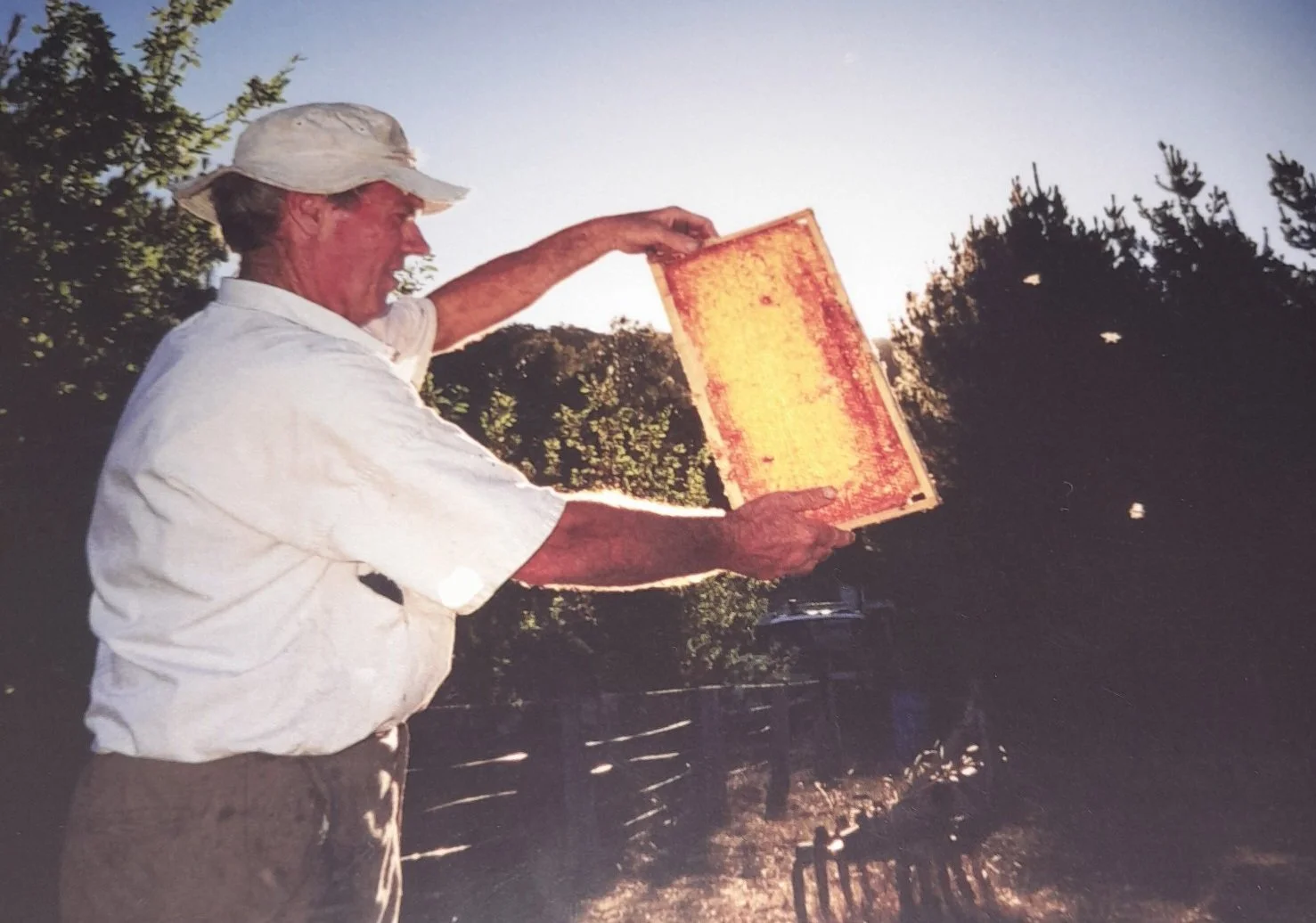
Michael with one of the frames of honey from his bee hives, c.1990
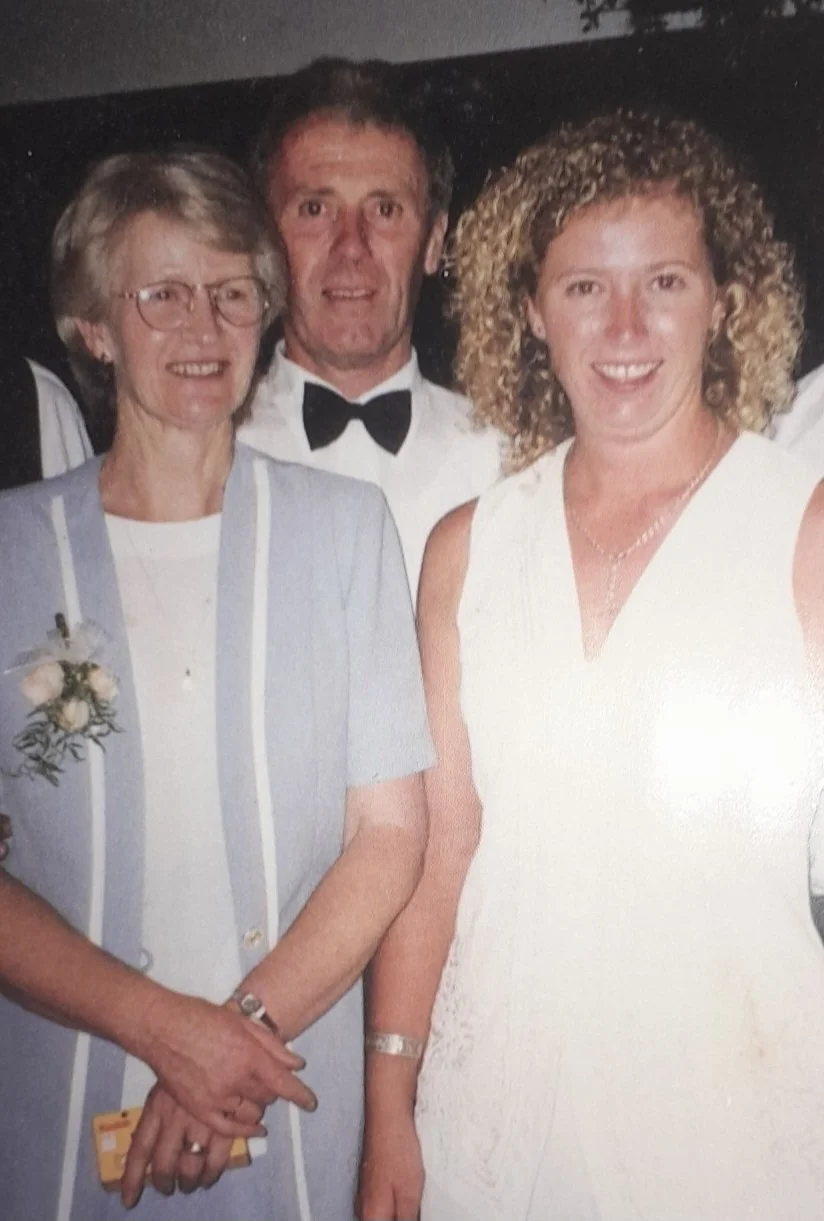
(L-R) Joyce, Michael and their daughter Kay at their son David’s wedding in 1998.
We earned enough money from merino wool, wool classing, and bee-keeping to put our three kids through boarding school at Yanco Agricultural High School near Leeton for the boys and Tara Anglican School in Parramatta for Kay. Ian studied engineering and worked in hydraulics for the Department of Defence on Garden Island. Kay followed in the footsteps of my great grandmother and studied nursing, and midwifery. David went to Orange Agricultural College (which became part of Sydney University and then Charles Sturt University) to study and leased a cropping property near Moree to grow grain and legumes. He later bought that property. He has twin boys at home and another son at school in Sydney. We sold our place in Binda and moved to Delungra to be closer to them. Inverell is our closest town and Moree is about 100km away.
There’s no such thing as retiring. I kept up the wool classing and only gave it up last year when I was 84 years old. I still have a bit of a garden at home. I do a bit of paddock work and lease my land for pasture for sheep. The drought of 2019-2021 hit us hard.
In 2019 I was diagnosed with cancer in my jaw bone, which has been treated but I still get it checked once a year with a specialist in Armidale.
Looking back, I think it was a darn good move to come to Australia with the BBM. I couldn’t see me doing what I’ve done in the UK – not unless I had the Bank of England behind me! It was a big change and it took a while to adjust to the way things are done here, but it was worth it.